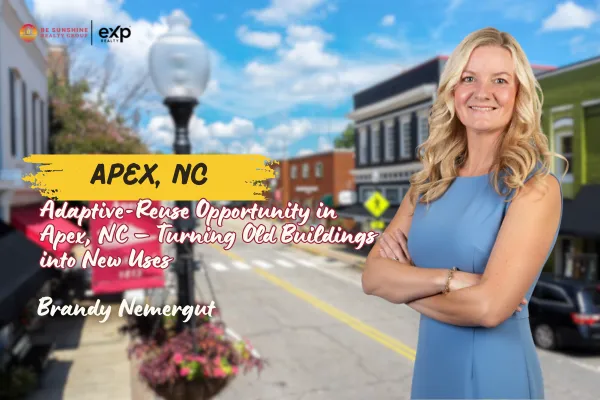
Adaptive-Reuse Opportunity in Apex, NC — Turning Old Buildings into New Uses
Adaptive-Reuse Opportunity in Apex, NC — Turning Old Buildings into New Uses
If you’re a small developer or creative investor evaluating Apex today, you should know there’s more than just subdivision land or new-build lots on the table. Historic downtown Apex and a handful of underutilized commercial or industrial buildings offer a unique—and increasingly attractive—chance for adaptive reuse: converting old structures into live/work lofts, studios, mixed-use housing/retail, boutique offices, or creative spaces. With the right vision, discipline, and local know-how, these can pencil out with lower land cost, instant texture, built-in community character—and strong appeal to residents who prize walkability and heritage.
Below is a deep dive into why adaptive reuse works in Apex, what to watch out for (zoning, code, financing), and how a heritage-savvy Realtor or broker becomes an essential partner in executing these deals.
Why Adaptive Reuse Makes Sense in Apex Right Now
🔹 Growth + Demand + “Character Premium”
Apex has evolved from a small railroad town into a thriving suburb with strong demand across housing, retail, and mixed-use — making full build-outs pricey. reuse helps capture value from old inventory. The town prided itself as “The Peak of Good Living.” Apex Chamber of Commerce+1
The downtown core remains a vibrant, intact historic district, with walkability, charm, festivals, and nightlife — exactly the kind of lifestyle draw that attracts buyers and renters looking for more than typical cookie-cutter suburbs. Wikipedia+1
Adaptive reuse allows investors to offer something rare: character-rich housing or mixed-use with heritage, pedestrian-oriented context, and proximity to downtown amenities — a niche often underserved by new construction.
🔹 Town Vision, Historic District, and Overlay Framework Support Reuse
The downtown and surrounding older neighborhoods are covered by the Small Town Character Overlay District (STCOD), which aims to preserve historic character while allowing redevelopment and adaptive reuse under defined design standards. Apex NC+1
The local codes (Unified Development Ordinance, UDO) explicitly account for “rehabilitation or relocation” of historic buildings — meaning reuse is not only tolerated but accommodated when done under the rules. Apex NC+1
Past successful adaptive-reuse projects — including the transformation of the old town hall into the Halle Cultural Arts Center — show that Apex values re-imagining old buildings for modern uses rather than tearing them down. Wikipedia+2thehalle.org+2
🔹 Precedent: Proven Local Success
The Apex Union Depot (built in 1914) is a classic example of adaptive reuse: originally a railroad station, it now functions as the town’s visitor center, chamber offices, and event space — preserving architectural heritage while fulfilling modern civic use. Wikipedia+25 West Mag+2
The Halle Cultural Arts Center: the 1912 brick Town Hall was repurposed in 2008 into a public cultural facility — with theatre, galleries, and rental space — winning design awards for blending preservation with contemporary needs. Wikipedia+2Apex NC+2
These success stories demonstrate that adaptive reuse isn’t theoretical in Apex — it’s actively part of the town’s identity and growth strategy.
What Adaptive Reuse Entails — Feasibility, Entitlements & Key Challenges
Adaptive reuse offers opportunity — but it also comes with complexity. Below is a feasibility checklist and common hurdles (with what to watch out for).
✅ Zoning, Overlay & Land-Use Compatibility
Start by verifying that the building lies within the historic district / overlay area (or an area where reuse is permitted). The Town provides maps for the National Register Historic District, State Inventory structures, and the Small Town Character Overlay. Apex NC+1
Under the Overlay’s regulations (UDO Section 6.3), redevelopment or adaptive reuse requires compliance — including design standards for materials, setbacks, building massing, and facade harmony. Apex NC+1
For a non-residential-to-residential or mixed-use conversion, confirm you meet building code, egress, fire, parking, utilities, and historic-review requirements. Some historic structures may be “contributing” or individually listed — requiring extra care, possibly variances if significant changes are proposed. Apex NC+1
🛠️ Structural, Code, and Physical Upgrades
Older commercial/industrial buildings may have outdated structural systems, insufficient light/ventilation, sub-par plumbing/electrical, lack of insulation, or inefficient HVAC. To convert to residential or live/work spaces, upgrades may be costly.
Egress & accessibility (stairs, ramps, fire exits, ADA compliance) must meet modern codes— often requiring modification that must be sensitive to historic fabric.
Parking and service access: downtown buildings may rely on shared public parking lots or limited street parking; adding residential units may strain parking capacity, requiring creative solutions or negotiated agreements.
Noise, vibration, or environmental issues (if industrial past) may require remediation, especially if converting industrial to residential.
💰 Economics, Financing, and Incentives
Hard and soft costs (structure upgrades, systems, code compliance, historic-compliant materials) often exceed those of new construction — include them in your pro forma.
However, reuse can offset land-acquisition costs, avoid new infrastructure fees, and tap into a market paying premiums for historic and walkable housing.
Where applicable, historic-rehabilitation incentives may be available (tax-credit programs, local façade grants under the Overlay) — but only if rehab follows preservation standards and receives approval. Apex NC+1
Potential cash flow/rent premiums: live/work lofts, creative studios, or mixed-use units near downtown tend to attract renters or buyers willing to pay more for walkability, heritage feel, and proximity to shops, restaurants, and cultural amenities.
🗺️ Long Lead-Times & Review Process
Under the Overlay, adaptive reuse proposals require plan submittal, design-review approval, and possibly variance hearings. The non-residential exempt site-plan form indicates at least one 10-business-day review cycle, though many projects involve multiple review rounds. Apex NC
If residential use is added, or significant interior rework is done, expect building-permitting (plumbing, structural, electric), inspections, and possibly historic-oversight — all adding time and cost.
Market timing matters — reuse deals may take longer than typical new-builds, so carrying costs, financing cash-flow gaps, and pre-leasing or pre-sale strategies must be carefully considered.
What Adaptive-Reuse Could Look Like in Apex: Use Cases & Opportunity Types
Here are several adaptive-reuse archetypes that work — or could work — in Apex, especially in downtown or near historic corridors.

How a Realtor / Broker Adds Value — From Sourcing to Wrap-Up
Because of the complexity involved, having a heritage-savvy Realtor or broker on the team can make or break an adaptive-reuse deal. Here’s how they elevate success.
🔎 Off-Market Sourcing & Early Deal Flow
Many ideal adaptive-reuse properties are off-market — old warehouses, underused commercial buildings, vacant storefronts, or under-leveraged historic assets. A rep who monitors research-triangle area real estate and local historic-district listings can uncover leads that others miss.
Brokers can approach long-time owners (families, small businesses, legacy landlords) about potential sale or lease-to-own structures — often yielding better deals than hitting the open market.
🧭 Zoning & Entitlement Strategy + Due Diligence
They can pre-screen properties: check whether the parcel lies inside the historic district or overlay; confirm if adaptive reuse is allowed under current zoning or if variances are needed.
They guide you through design-review processes, help prepare submissions (site plans, elevations, materials, layout), and anticipate likely Town comments or concerns (setbacks, façade materials, parking, ingress/egress). For non-residential reuse in the Small Town Character Overlay District, there is a prescribed site-plan review process. Apex NC+1
They coordinate with architects, preservation specialists, and contractors familiar with historic buildings to estimate realistic rehab budgets and ensure compliance.
📈 Market Analysis, Pro-Forma & Exit Planning
They model rental or sale values for live/work lofts, retail + residential mixed-use, or creative spaces — factoring in heritage premium, downtown demand, and limited supply.
They evaluate holding-cost risks, financing stacks (hard/soft costs, rehab vs build-out), and projected returns — giving you scenarios for both conservative and upside cases.
They plan exit strategy: either retail sale, long-term rental, or mixed-use income — aligned with local demand trends, downtown event calendar, and community growth.
🧩 Branding, Leasing & Pre-Marketing for Adaptive Use
A good broker packages the project not just as “old building + renovation” — but as a lifestyle and value play: “live in a 100-year-old brick loft a five-minute walk from Salem Street shops and weekend festivals.”
They leverage local festivals, community identity (historic downtown, social district, arts center), and proximity to parks and greenways — to target creative professionals, remote workers, retirees, or young couples seeking unique housing.
They coordinate pre-leasing or early-marketing (for mixed-use) to secure tenants or buyers before rehab is complete, mitigating vacancy risk or carrying costs.
Key Risks and What to Plan For — Adaptive Reuse Is a Long Game
Adaptive-reuse in historic districts isn’t a quick flip:
Time and uncertainty in approval process — review cycles, potential revisions, variances, possible community or preservation group input. Expect at least a 6–12 month lead time before occupancy.
Higher upfront and soft costs — structural repairs, code compliance, materials matching historic character, utility upgrades, and possible remediation.
Parking and infrastructure constraints — downtown lots may have limited parking; adding residential or retail can stress existing capacity.
Resale/rental market is niche — buyers/users must value heritage, walkability, and downtown charm. This limits pool compared to standard suburban product; may lengthen hold time or require premium positioning.
Maintenance liability — older buildings come with deferred maintenance, unknown code surprises, and ongoing upkeep; budget and team reliability are essential.
Where to Find Opportunity — What to Watch and Where to Look
Historic District / Overlay boundaries: consult the official maps available via the Town’s “Historic District and Properties” page — these show which parcels qualify for adaptive reuse under overlay rules. Apex NC+1
Underutilized commercial / warehouse buildings near downtown — near Salem Street, old rail-associated parcels, or mid-century light-industrial zones. The old industrial sites (e.g., near the rail corridor) are often flagged for potential redevelopment, especially in local planning documents considering new rail-transit station opportunities. ncdot.gov
Former civic/institutional buildings — like the old Town Hall (now Halle Cultural Arts Center) or decommissioned warehouse or municipal buildings — especially if vacant or underused. These often have large floorplates, character, and easier conversion potential (less demolition).
Conclusion: Adaptive Reuse as a Strategic Play — If You Do It Right
Adaptive reuse in Apex isn’t for everyone. It demands patience, capital, regulatory savvy, and a commitment to preserving character while creating modern, usable space. But for developers and investors willing to navigate the complexity, the benefits are compelling: low-cost land relative to land-plus-new construction; instant context and history; potential demand from renters or buyers who value heritage, walkability, and local culture; and support from the town’s overlay, preservation mindset, and past success stories.
If you — or your team — know where to look, how to plan, and who to partner with (contractors, preservation-savvy architects, brokers), adaptive reuse in Apex offers a unique value proposition. As the town grows, demand for distinctive, character-rich housing and spaces will only increase — making adaptive-reuse deals not just nostalgia plays, but real long-term strategic investments.
For anyone looking to buy a home in Apex, NC, Be Sunshine Realty Group—brokered by eXp and led by Brandy and Lance Nemergut—offers the local expertise and personal attention that make finding the right home smoother and more successful.
Find EVERYTHING you need to know about The Raleigh Triangle in our YouTube Channel:
www.youtube.com/@LifeInRaleighNC
