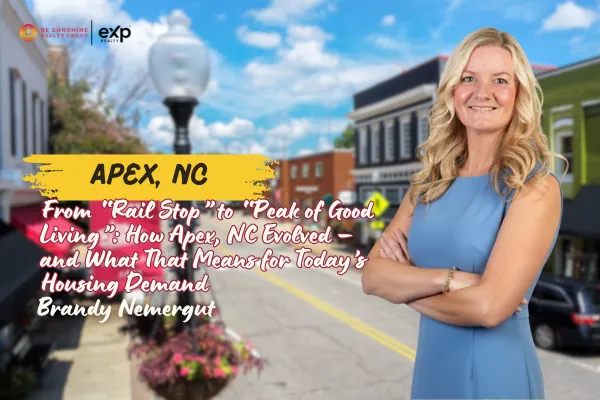
From “Rail Stop” to “Peak of Good Living”: How Apex, NC Evolved — and What That Means for Today’s Housing Demand
From “Rail Stop” to “Peak of Good Living”: How Apex, NC Evolved — and What That Means for Today’s Housing Demand
When you hear phrases like “best places to live,” “top-growth suburb,” or “boom town,” few have captured the transformation as cleanly as Apex, NC. Once a sleepy railroad stop, today’s Apex has become a high-income, high-growth suburban hub — rooted in a preserved historic core but expanding rapidly with modern neighborhoods, greenways, and high-demand housing. That evolution has far-reaching implications: for where builders invest, how buyers decide, and what neighbors can expect in the coming years.
Here’s the story of that transformation — anchored in data — and a look at what it means for demand by product type, and where future demand is likely to flow next.
🚂 From Depot to Downtown: The Early Story of Apex
The town that would become Apex was incorporated in 1873, thanks to its location on a rail line: it was the highest point on the Chatham Railroad route between Richmond, VA and Jacksonville, FL — hence the name “Apex.” Apex Chamber of Commerce+1
By 1900 the population was only 349. It rose to about 1,000 by 1920. But after the decline of local agriculture and tobacco markets, it shrank again: by 1930, population dipped to 863. apexnc.org
The historic core around the rail depot, centered on what is now Salem Street, was built out in the early 1900s — brick storefronts, a functioning depot (now the Apex Union Depot), and the beginnings of a “main street” vibe. Wikipedia+1
Over decades, as rail declined and cars became dominant, Apex remained a small, quiet town — until broader regional shifts made it attractive again.
In short: the roots of Apex’s charm — its walkable historic core, small-town feel, preserved architecture — go back more than a century. That vintage character still anchors much of how people think about the town.
📈 Explosive Growth & Rising Incomes: The New Apex
Population Boom
According to the town, by September 2025 the population estimate for Apex was 82,446. apexnc.org
That growth is part of a longer upward trend: in 2010, the U.S. Census counted only 37,476 residents. Wikipedia+1
Local forecasts by the town’s most recent Housing Plan anticipate continued rapid growth through the next decade — partly due to rising incomes and steady in-migration. communityscale.github.io+1
Income, Education & Workforce Profile
As of 2023, median household income in Apex was $138,442. Data USA+1
According to a regional summary report, some recent analyses put median household income even higher — around $153,125 — reflecting the influx of high-earning households. raleigh-wake.org
Per-capita income, educational attainment, and the proportion of households earning above the national median are also high, suggesting a strong demand base for quality housing and amenities. zoomprospector.com+1
What This Means
This data paints a picture of a town transitioning from modest-scale rural/blue-collar roots to a prosperous, educated, suburban community. The influx of higher-income, often professional households — many with ties to regional job centers — fuels demand not just for traditional suburban single-family homes, but also for:
walkable downtown living
greenway-adjacent neighborhoods
smaller-lot or attached product (townhomes, duplexes) for downsizers or smaller households
newer, amenity-rich developments that appeal to a higher-income segment
In short: Apex isn’t growing just in size — it's changing in character.
🏡 New Demand Patterns: What Buyers Want — and Where Builders Are Building
The Historic Core: Walkability + Character
The preserved downtown — with its early-1900s brick storefronts, the restored Apex Union Depot, and the official Apex Historic District — remains a major draw for buyers who value walkability, heritage, and small-town charm. Wikipedia+1
For “move-up” buyers downsizing from larger suburban homes — or for remote-work professionals wanting proximity to shops, restaurants, and community culture — small-lot single-family homes, renovated cottages, or townhomes near downtown offer a compelling package: lower maintenance, walkability, and easy access to amenities.
This segment of demand tends to stay resilient through cycles because it relies less on speculative value and more on lifestyle.
Suburban Greenways & Amenity-Driven Communities
As population rose, town planners responded with greenways, trails, and public-park investment. Today, Apex maintains over 13 miles of public greenway, and plans continue for expansion as development proceeds. apexnc.org+1
The Beaver Creek Greenway — one of the town’s more important corridor trails — recently completed a segment connecting multiple neighborhoods, parks, and retail/amenity centers, boosting desirability for greenway-adjacent homes. apexnc.org
For families and households that value outdoor recreation, safe bike/ped access, and a suburban-but-connected vibe, newer subdivisions near greenways or close to public parks become highly attractive. As town planning documents note, increasing density via smaller lots or attached housing helps meet demand while preserving open space. communityscale.github.io+1
New-Build Growth in Fringe Areas: Meeting Demand + Land Scarcity
As central and older neighborhoods filled up, growth pushed outward — especially toward southern and southwestern corridors (ETJ areas, outer Apex, and nearby New Hill / Friendship-Arcadia corridors). Local planning data shows the town expects continued expansion even with limited remaining land supply. communityscale.github.io+1
The “density + affordability” model is becoming more dominant: to meet demand for housing at more affordable price points, developers are building smaller lots, townhomes, and denser housing forms rather than large-lot single-family estates. communityscale.github.io+1
This trend attracts first-time buyers, younger families, and even downsizers who want newer homes without the price premium of larger lots.
🏙️ Amenity Catalysts: What Revitalization & Public Spaces Did for Demand
The transformation of Apex is about more than houses — it's about place. A string of amenity investments and community revival efforts helped anchor rising demand and shaped what residents expect.
Historic Downtown & Cultural Preservation
The 1906 train depot, rebuilt in 1914 after a fire, now stands as the Apex Union Depot — part of the larger Apex Historic District. Wikipedia+1
Recognizing the value of walkable, small-town charm, town leadership passed a “Small Town Character Overlay” in 2006 to preserve downtown’s architectural integrity and limit incompatible development. apexnc.org+1
Investments in adaptive reuse — e.g., the old Town Hall building is now the Halle Cultural Arts Center — and revitalization of Salem Street, made downtown a cultural and community hub. Wikipedia+1
This blend of preservation + revival created a unique “downtown-meets-suburb” identity — a draw for those who want charm and convenience without sacrificing home comfort.
Greenways, Parks & Access to Nature
Beyond historic preservation, town planning has prioritized greenway expansion. Apex now maintains a network of over 13 miles of greenways, with multiple corridors, including Beaver Creek, Middle Creek, Reedy Branch, and others. apexnc.org+1
Parks like Kelly Road Park and Apex Jaycee Park, along with natural-trail connections, provide outdoor recreation, family-friendly amenities, and walkability — factors that feed demand among active, outdoors-oriented buyers. Wikipedia+1
For many buyers, the presence of greenways and parks — especially now that segments are connected — becomes a decision factor equal to schools or commute time.
Vibrant Community Identity & Events
Part of what keeps many buyers anchored to Apex is its identity: a small town with community spirit, historic charm, and cultural amenities — but with the incomes, infrastructure, and convenience of a modern suburb. As one local-promoting summary puts it: "Apex is a vibrant, fast-growing community that blends small-town charm and authenticity with modern conveniences." raleigh-wake.org+1
That identity appeals to a broad cross-section: from working professionals commuting to the Triangle, to families wanting community and safety, to downsizers seeking walkability and low maintenance.
📊 Buyer Segments & Housing Demand: Who Wants What — and Why It Matters
Given demographic and amenity shifts, here’s a breakdown of key buyer segments and what kind of housing they tend to demand — in turn shaping what gets built, sold, and valued.
Buyer Segment
What They Want / Demand
Product Types in Demand
RTP / Triangle Professionals (singles, couples)
Convenience, commute-access, lower maintenance, social amenities, nightlife/dining/shops
Townhomes, smaller-lot single-family near downtown or greenways
Young families (first- or second-time buyers)
Space, yard, safety, schools + greenways, affordability
New-build single-family on fringe lots, or moderately-sized lots in newer subdivisions
Move-up / growing families
Larger homes, quality schools, community amenities, balance of commute vs space
Mid- to large-lot single-family in suburban or semi-rural zones
Downsizers / empty-nesters / retirees
Walkability, low maintenance, lifestyle amenities (parks, culture), smaller floorplans
Townhomes, cottages, historic-infill homes near downtown/greenways
Investors / rental market
Demand for rentals (families, professionals), stable appreciation, amenities attractive to renters
Mixed: townhomes near greenways or downtown, suburban single-family for families
Because demand is mapped across such a range of needs — from walkability to space to low maintenance — Apex’s housing market supports diverse product types. That diversity helps balance supply and keep the market relatively stable even as growth surges.
🔎 Looking Ahead: Where Demand Is Likely to Flow Next
Given current trends and constraints — land scarcity, growing income, demographic diversity — here are zones and product types likely to see continued demand:
Greenway-adjacent infill and redevelopment: As central Apex fills in, developers and planners will likely lean into preserving greenway/park access — small-lot infill, attached housing, and townhomes near trails will remain in demand.
Denser housing types on outer parcels: With limited land near the core and rising land prices, demand for denser housing (townhomes, duplexes, smaller-lot SF) will likely grow — especially to keep pricing accessible for younger or new household formations. This also supports municipal goals for efficient use of land and infrastructure. communityscale.github.io+1
Mixed-age / mixed-income housing mix: Given shifting household sizes — with many younger households or smaller households expected — the need for a variety of housing types (not just big suburban homes) will grow. communityscale.github.io+1
Continued interest from out-of-area buyers / relocators: With regional job-center growth, families and professionals relocating to Apex will continue fueling demand — especially those seeking a mix of suburban amenities with small-town charm.
In essence, expect a steady push toward walkable, amenity-rich, moderate-density housing — even as single-family suburban homes remain a core part of the mix.
🧑💼 The Agent or Developer Edge: Why Local Data + Insight Matters
In a market evolving as dynamically as Apex’s, local knowledge matters more than ever. Here’s how agents, developers, or investors benefit:
Smart product-type matching: Understanding which buyer segments gravitate to townhomes vs single-family vs infill/historic gives an edge in building or marketing the right product at the right price.
Timing & land-use strategy: As land becomes scarcer and demand shifts, knowing where growth pressures are — outward, greenway-adjacent, or infill — helps pick lots or parcels with upside potential.
Risk mitigation: With rising prices and increasing density, ensuring balance (amenities, green space, infrastructure capacity) means long-term stability — for homeowners and communities alike.
Resale/value forecasting: Using data on incomes, demographics, amenities, and demand — one can predict which segments will remain stable, which will grow, and where appreciation might outpace others.
Community integration mindset: Working in a town where history, identity, greenways, and livability matter — good developments respect that blend of “old + new,” which helps maintain demand over time.
🌟 Conclusion: Apex’s Evolution Is Not Just Growth — It’s Reinvention
Apex’s rise — from a 19th-century rail stop to a 21st-century high-income, amenity-rich suburb — is a textbook case of how history, planning, and demand converge. The transformation didn’t just bring more people — it shifted the town’s character, housing needs, and market dynamics.
For buyers, it means opportunity: whether you want a downtown townhouse, a greenway-adjacent family home, or a suburban lot with space and schools, Apex offers variety. For developers and agents, it means a nuanced, layered market — with demand across a spectrum of housing types.
And for the community: Apex’s evolution shows that growth, if managed thoughtfully, can preserve history, deliver amenities, and meet the needs of a changing population.
For anyone looking to buy a home in Apex, NC, Be Sunshine Realty Group—brokered by eXp and led by Brandy and Lance Nemergut—offers the local expertise and personal attention that make finding the right home smoother and more successful.
Brandy Nemergut, Realtor ~ eXp Realty Raleigh, NC
919-583-6895
Find EVERYTHING you need to know about The Raleigh Triangle in our YouTube Channel:
www.youtube.com/@LifeInRaleighNC
