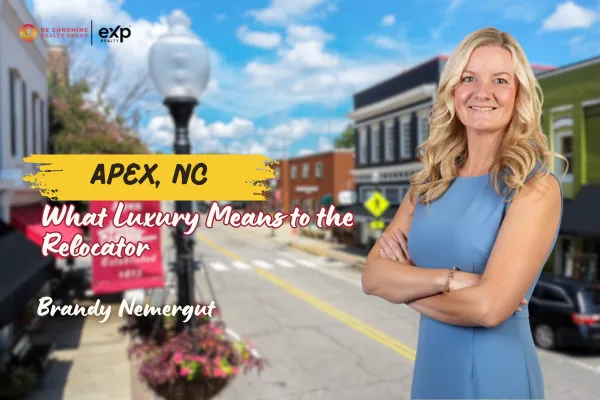
What Luxury Means to the Relocator in Apex, NC
What Luxury Means to the Relocator in Apex, NC
A family from the Triangle area — perhaps working near Research Triangle Park (RTP) — is relocating. They want a custom home: perhaps near lakes or green space, or in a high-amenity community just off NC-55 or US-64; maybe a property close to historic downtown, yet with luxury finishes, room to roam, and easy commuting access for work.
To them, “luxury in Apex” doesn’t just mean a big house. It means a lifestyle: oak-lined streets near small downtown shops, evening walks along neighborhood sidewalks or greenways, outdoor spaces, proximity to parks, maybe an EV-ready garage, and a home built for entertaining and ease. That expectation defines what “luxury” really means in a market like Apex: careful blending of comfort, custom, convenience — and community.
Market Context: Where Apex Stands Today
Apex today sits somewhere between suburban tranquility and rapid growth. According to recent data, typical home values hover around $600,202. Zillow+1
More specifically:
Recent median sale price (all home types) was about $613,000, up roughly 13% year-over-year as of late 2025. Redfin
Listing data shows median listing prices near $632,500 in 2025, though across different neighborhoods and types the spread is significant. Realtor+1
Demographically, many households in Apex are well positioned: the “typical” household income is quite strong — with median-household income estimates in recent years around $138,442. Data USA+1
What all this shows: the “average” home in Apex already requires a solid income. But true “luxury” — the upper echelon of the market — lies well above these typical numbers, and is defined by features, location, and lifestyle rather than just square footage.
Defining “Luxury” in Apex: Price Bands, Features & Neighborhood Expectations
What “Luxury” Means Locally
In a city like Apex, where the baseline home tends to sell in the $600–650K range, “luxury” typically means homes at or above the $1 million mark (or high-to-upper-six-figures close to that), though value and expectations depend heavily on neighborhood, lot size, finishes, and amenities.
Perhaps more important than price is what the home delivers: in this market, luxury often means:
Custom-built or high-end new-build construction (rather than entry-level track homes)
Chef’s‐style kitchens (large islands, high-end appliances, custom cabinetry), multiple living spaces (formal and informal), media rooms, home offices, and high-end finishes
Large garages — often 3-car — plus extra storage, potentially EV-charging ready
Outdoor “rooms”: covered patios or porches, outdoor kitchens, professionally landscaped yards, private backyards, mature trees, privacy and buffer from neighbors
Access to recreation and green space: proximity to parks, greenways, and lakes — especially the 50-acre lake and trails of Apex Community Park, or the greenway networks running through or near higher-end neighborhoods. Wikipedia+2Wikipedia+2
A blend of convenience and charm: easy commute routes (RTP, Raleigh), good schools, and the walkable-downtown small-town feel of historic neighborhoods (e.g., near the downtown district that includes Historic Apex Town Hall on Salem Street). Wikipedia+2whalenandco.com+2
In Apex, “luxury” is often as much about lifestyle fit — the balance between custom home, comfort, community, and access — as about square footage or opulence.
Where Luxury Homes Cluster
Luxury or near-luxury homes tend to cluster in certain pockets:
Established high-amenity neighborhoods or custom communities near major corridors (e.g., off NC-55 or US-64), where larger lot sizes and custom home opportunities remain.
Areas around larger-lot or estate-style homes, often with more mature landscaping, privacy, and space for yard amenities.
“Infill luxury” near historic downtown (Salem Street, downtown districts), where buyers pay for charm, walkability, and proximity to local shops/restaurants — sometimes paying a premium per square foot relative to newer, more suburban builds.
Newer high-end subdivisions or luxury-intent communities, where homebuilders target well-to-do buyers who want modern amenities, smart-home features, and planned convenience.
Because of this patchwork of neighborhoods and home types, inventory “quirks” emerge: at any time, there may be only a handful of “true luxury” homes available — many listings labeled “luxury” will be on upper mid-range homes (700–850K) that flirt with top-end status but may lack acreage, custom finishes, or premium amenities.
Inventory & Trends: What’s Available — and What’s Hard to Find
Inventory Realities
Although there is a broad spectrum of housing in Apex, true luxury homes remain somewhat rare. Recent overall market data suggests a tight inventory: one source notes 823 homes for sale (across all price ranges), with listing prices between the low hundreds of thousands and, for some, well over $2 million. Realtor+1
Because of this, lots of homes at the upper end of the mid-market get “close enough” to luxury — and in many cases may fulfill many buyer expectations, even if not strictly “estate-home” level.
That said: in neighborhoods or zip codes with premium reputations, African-price movements show variance. For example, one zip code area shows a median listing price of about $850,000 and median sold price around $736,000. Realtor
Market Dynamics for Luxury Homes
From the broader market, a few patterns stand out:
Median sale price has increased over the past year — signaling sustained demand even as interest rates and economic uncertainty remain. Redfin+1
However, “days on market” for typical homes has risen: in October 2025 the median was ~55 days, longer than in prior years. Redfin+1
Given the limited supply of true luxury homes, buyers often find themselves in “near-luxury” territory — and may need to choose between stretching for full luxury (with tradeoffs in wait time or price per square foot), or settling for high-end mid-market with upgraded finishes.
Thus, for many buyers, definitions of “luxury” are flexible: a $900–950K home with high-end finishes and lot size may “feel” luxury — even if it isn’t a million-dollar estate.
How Luxury Marketing Differs in Apex
Marketing a luxury home — or selling one — in Apex is not the same as marketing a standard listing. Because buyers care about lifestyle, not just square footage, marketing has to weave together story, place, and aspiration.
Some tactics that tend to work especially well in Apex’s luxury segment:
Cinematic storytelling & lifestyle imagery — video tours that move beyond interiors: twilight drone over wooded lots, aerial shots of tree canopies, sunset over the lake in Apex Community Park, walks along downtown Salem Street or greenways. These create emotional resonance with lifestyle buyers (commuters, families, empty-nesters).
Highlighting outdoor + amenity features — drawing attention to proximity to parks, greenways, lakes, and community recreational amenities; showing patios, outdoor kitchens, privacy buffers, landscaping, and neighborhood context (quiet streets, mature trees).
Staging interior upgrades — professional staging to showcase chef’s kitchens, media rooms, custom finishes, EV-ready garages, and flexible spaces (offices, gyms, playrooms), matching buyer expectations of a custom home.
Targeted buyer profiling & outreach — marketing to those with higher incomes, families valuing schools and community amenities, or professionals commuting to RTP or Raleigh, emphasizing commute times, access, and work-life balance.
Narrative framing — positioning the home not just as real estate but as “home base” for lifestyle: weekend backyard cookouts, children walking to downtown events or festivals, proximity to greenways and parks for a healthy active lifestyle.
Patience and trust-building — because luxury buyers often want to “feel” the neighborhood, show how the home fits into day-to-day life (quiet evenings, neighbor-friendly, safe, private), not just impressive finishes.
In Apex’s mix of historic charm and suburban growth, luxury marketing that balances “authentic small-town character” with “modern comfort” tends to resonate most.
What Buyer Strategy Looks Like in Apex’s Upper Market
For buyers in the upper end of the Apex market — whether looking for large custom builds, estate-style privacy, or commuter-friendly comfort — success often depends on a few strategic moves:
Financial readiness with jumbo pre-approval. Given price points often above a million, buyers need to go into the market with strong pre-approval, credit, and understanding of their true buying budget (considering taxes, maintenance, HOA fees, utilities, etc.). Given local incomes (median household income around $138K), buyers above median income are likely the ones competing in luxury. Data USA+2Census Reporter+2
Understanding “near-luxury vs true luxury” comps. Many homes priced in the high-six-figure range (e.g., 800–950K) may offer much of what a luxury buyer wants without the premium price tag — but may require compromise on lot size, privacy, outdoor amenities, or the feel of a custom build.
Ownership cost modeling. Luxury homes cost more than mortgage: think maintenance, landscaping, larger lot upkeep, possible HOA fees, utilities, especially when there are pools, landscaping, smart-home systems, or large outdoor/exterior spaces. Buyers should run realistic cost projections before committing.
Patience and due diligence. Inventory is limited; ideal homes may come occasionally and sell quickly. Touring multiple properties, comparing neighborhoods (legacy subdivisions, new developments, historic downtown, large-lot rural outskirts) helps define what “luxury” means personally.
Focus on lifestyle fit, not just square footage. For many buyers moving to Apex, lifestyle — the blend of community character, amenities, commute, and home comfort — is more important than having the biggest house. A smaller “luxury” home in the right location may outperform a larger one in a less desirable pocket.
Why an Apex Luxury Specialist Matters
Given the complexity of what “luxury” means in Apex — the mix of older neighborhoods, infill near downtown, newer subdivisions, custom builds, large-lot homes, and proximity to amenities — navigating the upper end of the market is not straightforward.
A local luxury-market specialist brings essential value:
Deep familiarity with neighborhood nuances: which pockets offer privacy, landscaping, mature trees, walkability, greenways, or lake/park proximity.
Insight into which homes are “priced for lifestyle” versus “priced for size” — helping buyers decide quickly whether a home truly offers the luxury they seek, or is merely top-of-mid-market.
Understanding of market dynamics: where supply is especially limited, where inventory tends to linger, and how staging, presentation, and marketing timing affect outcomes.
Ability to target and attract the right buyers: high-income professionals, families, or retirees looking for comfort + convenience; using marketing that resonates — lifestyle tours, drone shots, community storytelling, and staged walkthroughs.
Realistic counsel on investment value, resale potential, and long-term ownership costs — especially important for buyers who view luxury homes as both residences and long-term assets.
In short: when dollars run high, and expectations even higher, the margin for error shrinks. A luxury specialist is not optional — they become a strategic partner.
Success Stories: What Luxury Looks Like in Action
Consider two hypothetical, yet representative, scenarios:
Historic-Adjacent Luxury: Infill on Salem Street
A buyer purchases a 3,500 ft² custom-built home on a quiet street just off downtown Apex (Salem Street area). The home features a gourmet kitchen, hardwood floors, 3-car garage, and a covered back porch leading to a professionally landscaped yard. The walkability to downtown shops, festivals, and restaurants — combined with the charm of mature trees and established neighborhood — gives this home strong lifestyle appeal.
Because appreciation in downtown-adjacent properties tends to be steady, the buyer sees long-term value: lower maintenance (smaller yard, less land), easy access to amenities, and strong resale potential. Marketing that emphasized “walk to downtown nightlife, stroll to festivals, easy commute” helped close the deal — not just the home, but the lifestyle.
New-Build Estate Near High-Amenity Communities
Another buyer opts for a brand-new luxury build in a newer, amenity-rich neighborhood off a main corridor near NC-55 or US-64. The home spans 4,800 ft², features a media room, office, EV-ready 3-car garage, and a large backyard with outdoor patio — ideal for family gatherings. The neighborhood offers greenway access, proximity to parks, and a commute-friendly route to RTP or Raleigh.
For this buyer, staging was critical: twilight drone shots to highlight tree canopy and lot size, professional video showing nearby greenways and parks, and open-house staging that emphasized both modern finishings and comfortable living. The result: buyer perceived this home as a “ready-made lifestyle upgrade,” willing to pay a premium over comparable mid-range homes.
Both success stories share a pattern: luxury in Apex is rarely just about size — it’s about fit, lifestyle, and presentation.
What Luxury Buyers & Sellers Should Watch Out For
Limited inventory: True luxury homes rarely stay on the market long; those that linger may lack some desirable amenity or location. Patience and flexibility are essential.
Over-pricing risk: Without careful comparison to both comps and lifestyle factors, listing a home too high (based purely on square footage or lot size) can backfire.
Maintenance & ownership costs: Bigger homes, larger yards, outdoor features, newer appliances — all bring ongoing costs. Buyers should plan realistically for upkeep, insurance, taxes, etc.
Lifestyle mismatch: A large house in a cookie-cutter neighborhood may disappoint if the buyer values walkability, character, or community feel.
Expectations around resale: What’s “luxury now” may be mid-market in a few years if newer developments or high-end subdivisions proliferate. Investors and buyers should think long-term about desirability, not just current shine.
Conclusion: Luxury in Apex Means More Than a Price Tag
In Apex, North Carolina, “luxury” isn’t a fixed label — it’s a flexible combination of home quality, neighborhood, amenities, and lifestyle fit. As median home prices sit in the low-to-mid six-figures, true luxury homes often hover at or above the $1 million mark, but many deals just below that threshold deliver on lifestyle expectations and can feel every bit “luxury.”
Because what matters is context — commute to RTP, proximity to parks or downtown, custom finishes, outdoor space, privacy — the role of a seasoned, local luxury-market specialist becomes paramount. That agent, with deep local knowledge and a sense for what “luxury” means to different buyers, can guide both sellers and buyers to better decisions, smoother closes, and satisfied long-term homeowners.
For buyers: define what “luxury” means to you — is it a big lot, a custom kitchen, walkability, or a perfect commute? For sellers: invest in staging, lifestyle-driven marketing, and target the right audience. In Apex, luxury sells when lifestyle, story, and value align.
For anyone looking to buy a home in Apex, NC, Be Sunshine Realty Group—brokered by eXp and led by Brandy and Lance Nemergut—offers the local expertise and personal attention that make finding the right home smoother and more successful.
Brandy Nemergut, Realtor ~ eXp Realty Raleigh, NC
919-583-6895
Find EVERYTHING you need to know about The Raleigh Triangle in our YouTube Channel:
www.youtube.com/@LifeInRaleighNC
