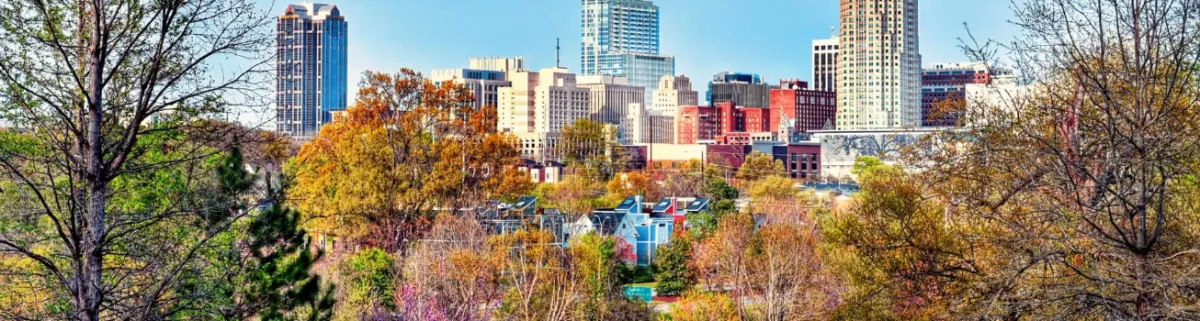
Best Location To Live In Raleigh NC | Watch This First!
Best Location To Live In Raleigh NC | Watch This First!
Are you considering relocating to the Raleigh area and wondering which area would be the best fit for the lifestyle you're looking to live? We relocated here six years ago from California and when you start to explore the Raleigh area, you'll notice just how big it really is. Along with Raleigh having a lot of surrounding suburbs, It can make your head spin when you first get here.
Today, I'll be breaking down what to expect in each direction you head in Raleigh from north, south, east, and west, starting right in downtown Raleigh. Now, starting with a fun fact, Raleigh is about 20 to 30 minutes away from so many of the surrounding suburbs. So if you need to work in the Raleigh area, but don't want to live in a big city surrounded by all the hustle and bustle, Raleigh There are plenty of surrounding suburbs to continue with an easy commute.
Looking at the map here, I'll show you a quick glance at the different areas, and then we'll dive in and explore them in more detail. Looking west of Raleigh, you'll find many conveniences and a lot of established communities with beautiful mature tree landscapes. And full disclosure, this area comes with a considerable price tag in comparison to the surrounding areas.
Looking north of Raleigh, this is the area where you'll find established mature trees and intertwined with suburban developments that are more reasonably priced than the west side. On the south and east side of Raleigh, you'll find a mix of suburban living meets rural living with some scenic farmland country landscape dotted with growing crops, horses, and cows.
Okay, let's just go ahead and jump right on in and we're going to start with west of Raleigh. This is where you'll find the most development in established suburbs like Morrisville, Cary, and Apex. And that's because of its close proximity to the RDU airport, as well as the Research Triangle Park, also known as the RTP.
The Innovation Park at the center of the triangle surrounds three major universities here. There's Duke University, NC State, and Chapel Hill. The RTP has now become the pillar of the entire Triangle area, which is a 7, 000 acre business park in Durham and the largest high tech research and development park in the United States.
Home to over 300 companies with top names and good paying jobs to the region. You'll find companies like SAS, IBM, Cisco, Fidelity, and Apple, just to name a few. This area is highly sought after and continues to attract many families and executives to this area between its convenient commute times, proximity to amenities, and great outdoor spaces, greenways, parks, shops, restaurants, and more.
These suburbs have nearly been completely developed with housing communities and what land is left is being developed with townhome communities. With the development of the Research Triangle Park in the 1960s, Cary grew from a quiet town of a few thousand people to a booming bedroom community. Fun fact, the first plant unit development was built in Cary called Kildare Farms.
By the 1970s, the population nearly tripled and then doubled during the 1980s and again during the 1990s. As communities continue to develop and if you think it stopped there, think again. The booming growth hasn't stopped yet with just under 200, 000 residents who call Cary home. In the past few years, downtown Cary underwent a major project investing over 69 million dollars.
into the area. They've also added Fenton, an upscale shopping and restaurant mall. And as you drive around, you can still see new shopping centers underway and a lot of multi use development under construction. You'll especially notice this as you head a little South and West into areas like Apex and West Kerry.
These areas were previously underdeveloped and now this land has been transformed. into a community development and multi use developments. With all the developments in these communities west of Raleigh, there's been plenty of time to build up all the conveniences one could want. You'll find a great mix of ethnic and trendy eateries, great grocery stores like Wegmans, Whole Foods, and Trader Joe's.
Apex has a Costco and Morrisville is conveniently close to the RDU airport. In this area you'll also find some of the best greenway systems with over 160 miles of trails that are mostly paved and intertwined through the triangle area. It also has some of the best schools within the Triangle area.
Between the location, schools, and amenities, these west side areas are highly desirable and sought after, which reflects in the housing prices. Many of these communities west of Raleigh come with some of the highest housing prices in the region. The median price point for a home in Cary is approximately 595, 750.
Apex, approximately 584, 390. And Morrisville is around 520, 000. As of May 2024. Also consider this is combining single family homes along with townhomes. So looking at the breakdown of price per square foot, carry cost around 257 per square foot. while Morrisville will cost around 242 per square foot and Apex is around 239 per square foot.
This is compared to about 430, 000 in Raleigh coming in at around 230 per square foot. Next, let's head north where you'll find quite a bit of established development along with some newer communities. North of Raleigh includes communities like North Raleigh, the popular Wake Forest, and Roseville. In this area, you'll notice some differing landscape here.
North Raleigh is going to be lush and green and is close to Falls Lake. When you head north of Raleigh, you'll notice a separation between two different types of development and time periods. The first section are the communities immediately to the north of Raleigh, which really started to boom in the 1970s as the population increased and branched out.
Then there was a separate growth going on in Wake Forest, primarily due to Wake Forest University. However, in 1956, the college was relocated to Winston Salem and sold the campus to the Southeastern Baptist Theological Seminary. Which was shocking to the community as it had always been closely associated with the college.
So the growth of Wake Forest slowed and in the 1990s, it picked right back up again and this region started to boom again. Fast forward today and here on the northern boundaries of North Raleigh and the southern boundaries of Wake Forest, expanding out and meeting in the middle. bringing new development to the areas in between like Roseville.
A fun fact, Roseville was the fastest growing town in the entire state among municipalities with populations of 5, 000 or more growing 150 percent from 2010 to 2020. The attraction to the areas north of Raleigh is a combination of its affordability with lower housing prices in comparison to the west that was previously talked about.
While still being a reasonable driving distance to major amenities along with a mix of rural farmland landscapes meets suburbia life. The median price point for a home in Wake Forest is approximately 543, 758. and Roseville is slightly less at 530, 000. So looking at the breakdown of price per square foot, Wake Forest cost about 211 per square foot and Roseville is going to be around 200 per square foot.
One of the cons about living in one of the communities north of Raleigh, especially Wake Forest, is the traffic. The main highways are 98 that will take you into Durham. And US 1, which turns into Capitol Boulevard, heading into Raleigh, which can get pretty congested, especially during high commute hours.
A plus for many that live here in Wake Forest is that you can find just about all the major conveniences you can want, including the beloved Wegmans. And rumor has it that there's plans to add a Costco in the area behind Lowe's in Grove 98. But! Time will tell for sure. For now, people have to drive into Raleigh for Costco, along with more food and restaurant options.
But, I feel like for most people, Wake Forest has more than enough to be content without having to drive into Raleigh all of the time. Now let's head into the areas east of Raleigh. This is where you'll find communities like Knightdale, Wendell, and Zebulon. You'll find these towns aren't quite as developed.
However, they are all going through some major growing spurts, especially after the prices skyrocket in the triangle on the west and north side of Raleigh. And as less and less land is available, it continued to push development into the side southeast of Raleigh. While some think these areas are too far removed from Raleigh, Personally, I think it's still relatively easy commute with times averaging around 30 minutes to the RDU airport or the RTP from Knightdale, while Windell and Zebulon are going to be around 45 minutes.
And if you're a transplant like me, that commute is going to be no big deal, especially considering the traffic is light in comparison to places like California, New York, and Florida. In this area, while you'll find a lot more new construction developments, there's still a lot of wide open space with a landscape of growing crops and farm animals from horses intertwined through the housing developments.
Things really changed for this area back in the late 1990s and early 2000s with the completion of the first section of I 540, which locals refer to as the Outer Beltline. This segment of the Beltline connected Knightdale to the airport, RTP, and further west into Cary and Holly Springs, which significantly reduced traveling time.
As a result, we've seen a lot of new development popping up across Night dome, but even more so in its neighbor to the east, Wendell. This is mainly due to the development of Wendell Falls, which is considered to be a resort style living. This community is a little over halfway completed. It'll eventually have nearly 4, 000 homes and they've been adding multiple restaurants, shops, they have a public store.
school, hospital, apartments, and more. There's also miles of trails to enjoy and sidewalks to walk into the shopping areas or hop on your golf cart and head over as it's a golf cart friendly community. Windell Falls is an amazing option for those looking to have easy access to Raleigh at a fraction of the price and it's right off I 540 so it only takes about 15 minutes to get to North Hills, Raleigh.
Window also has a cute historic downtown with an old fashioned general store, the Bearded Bee Brewery that's family friendly and has rotating food trucks. 41 North Coffee Shop that has some delicious treats and so many more. Then if you head a little further east, you'll hit Zebulon, which has seen massive growth in the past few years, though it's still relatively small with a population just over 10, 000 residents.
And because these towns haven't had the same history of growth and development that you'll find to the west and north of Raleigh, you'll notice there are not a lot of amenities on this side of town. You do have access to a handful of restaurants in each of these towns, along with grocery stores and fast food chains and even some big box stores, but no major entertainment options like bowling or movie theaters.
So many who live here still have to head into Raleigh, however, as previously mentioned, the commute is relatively easy to get into Raleigh, taking around 20 to 30 minutes, up to 45. And, on a positive note, there are a lot of new developments in the making. Aside from the ones I talked about in Windell and Knightdale, also has some major developments on the horizon.
Thank you for listening. I talk more about this in my Boomtown video here, if you want more information. Another positive trade off for living in this area is that you'll find much more affordable housing options. The median home prices in Knightdale is approximately 379, 966. Windell's going to be around 410, 642 and Zebulon around 359, 555.
So looking at the breakdown of price per square foot, Night Dell is around 190 per square foot. Windell's going to be around 205 per square foot and Zebulon is going to be around 189 per square So if you're looking for your housing dollars to stretch quite a bit further while still having easy access to Raleigh and don't mind having a bit more of a commute, then these towns are definitely a viable option to consider.
Now, these towns are experiencing the most expensive housing. And that's mainly driven by the expansion of I 540, the outer Beltline I mentioned earlier. Along with the fact much of the land has been built out on the west side of Raleigh and housing prices have skyrocketed. skyrocketed. Another plus with the completion of I 540 is the fact it will greatly improve access for residents of communities like Fuquay Verena, Garner, and Clayton.
And these towns also have had a lot of available land to build on, many of which are wooded lots. While many areas south of Raleigh have a much more rural and farmland feel, you'd find up north. So it's the perfect mix for lots and new development. And we are definitely seeing a lot of new development communities and businesses popping up in the last few years in these towns.
There's even a Publix being built on the border of Knightdale Raleigh right off I 540 exit. And while there's no Whole Foods, Wegmans or Trader Joe's quite yet, Garner does have its own Costco and I hear Wake Forest should be getting one in the next couple of years. You'll also find more affordable housing options here, but that really depends on which part you're looking at.
And things get more expensive as you move from east to west. The furthest south and west community is Clayton. which has a median price point of approximately 369, 966. And if we break down price per square foot, Clayton is about 189 per square foot followed by Garner with a median price point of approximately 400, 000 with around 191 per square foot.
Then, we have Fuquay Verena with a median home price of approximately 433, 991. If we break that down, that comes out to about 198 per square foot. And last but not least, we have Holly Springs. And while it's technically south of Raleigh, it doesn't follow the typical rhythm of other southern communities.
And I feel like that's because of its accessibility to its popular neighboring suburbs like Cary and Apex, which made it fairly easy to commute into the RTP or the RDU airport. not to mention having close access to all the neighboring amenities. So that's a definite perk that other southern communities don't have access to as easily.
Up until recently, I 540 stretch ended in Holly Springs. However, many are looking forward to this completion to fully connect Holly Springs and relieve some of the 55 bypass congestion. Surprisingly to me, the median house prices here are significantly higher at approximately 569, 301, breaking that down to about 224 per square foot, which rivals neighboring Apex.
Holly Springs also continues to have more community and business development coming in, including some great outdoor spaces and parks. Good rated schools and old downtown that continues to be revitalized by the city. bringing in fun new shops and restaurants like bless your heart boutique the pimento tea room osha niche wine lounge my way tavern fresh local ice cream and then on the newer section holly springs town center with all the typical box chain stores and restaurants and just like holly springs i feel Like, as I 540 expansion is completed, this will open up more development opportunities to the southern communities, and there's many already underway between all the building in the Windell Falls area.
Knightdale has an extensive plan for new business and community development, as well as Clayton with two big projects. If you want to find out more about those developments, make sure to watch my future growth. and new development in Cary video or my moving to Knightdale, North Carolina, new growth and development that are coming right in these videos.
That about wraps up our snapshot of each of the areas in the west, north, east, and south of Raleigh and what the lifestyle is like living in each of these towns. If you found this information helpful, please click the like button below so others like you can find this information as well. And if you're considering relocating to the Raleigh area or anywhere surrounding the Raleigh area and looking to purchase a home, we would love to help.
All you have to do is reach out to us. My number is right here on the screen. Whether you want to give me a call, shoot me a text, or send me an email, we would love to chat. Until next time, we'll see y'all later.
Brandy Nemergut, Realtor ~ eXp Realty Raleigh, NC
919-583-6895
Find EVERYTHING you need to know about The Raleigh Triangle in our YouTube Channel:
youtube.com/@LifeInRaleighNow
