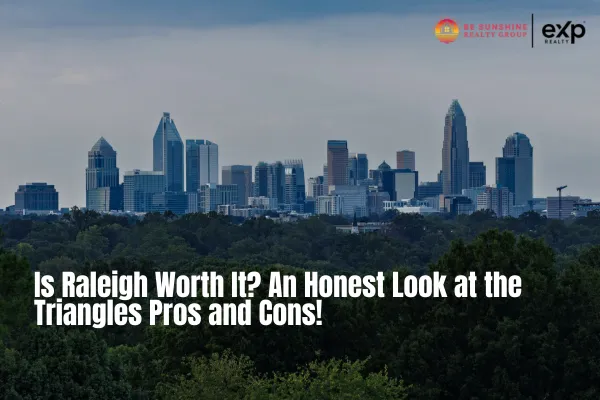
Is Raleigh Worth It? An Honest Look at the Triangles Pros and Cons!
Raleigh, North Carolina, looks like an easy “yes” on paper.
Good jobs. Strong schools. Parks and greenways everywhere. A growing food scene. Access to the beach and mountains. And enough people moving here to make you wonder if there was a group chat you somehow missed.
But here is the part that does not always make it into the relocation brochures:
Where you choose to live matters tremendously.
Choose the right area, and Raleigh can give you an incredible lifestyle. Choose a location that does not fit your work, school, commute, or everyday routine, and even a beautiful home can start feeling a lot less convenient than you expected.
My family and I moved here from Southern California without seeing it first, so I understand what it feels like to research a completely new area from hundreds or thousands of miles away.
And I also know some of the things relocating buyers tend to overlook.
Raleigh's Opportunity Is One of Its Biggest Advantages
One of the biggest reasons people continue moving to Raleigh and the greater Triangle is opportunity.
The Triangle has a little bit of everything, including technology, healthcare, biotech, research, universities, state government, startups, and major corporations.
Research Triangle Park is nearby. You have major universities such as NC State and Duke, large healthcare systems, and employers spread throughout Raleigh, Durham, Cary, Morrisville, Chapel Hill, and surrounding communities.
People are not simply moving to Raleigh because they want a different house.
They are moving for the entire package: career opportunities, education, healthcare, airport access, community, and a lifestyle that can still feel more manageable than many larger metropolitan areas.
But opportunity comes with a trade-off.
More jobs attract more people. More people create more demand. And demand has a funny way of showing up in home prices, traffic, development, and everyday life.
Raleigh Is Not the “Cheap Hidden Gem” It Once Was
If someone tells you Raleigh is still dirt cheap, there is a good chance they are remembering prices from years ago.
Compared with markets such as Southern California, New York, Boston, Seattle, Washington, D.C., and other expensive metropolitan areas, Raleigh can still provide attractive value.
But desirable areas such as Cary, Apex, Midtown Raleigh, North Raleigh, Holly Springs, and portions of Wake Forest are not exactly sitting in the bargain bin.
And your purchase price is only one part of the equation.
When buying a home in the Raleigh area, you also need to consider your commute, property taxes, HOA fees, insurance, school situation, maintenance, and any repairs or upgrades the home may need.
A home can look affordable online and still cost you more than expected once you consider the lifestyle that comes with it.
That is why I encourage people thinking about relocating to Raleigh to reach out early in the process. We can look at your budget, commute, lifestyle, school needs, and priorities before you become emotionally attached to a house that may not actually work for your everyday life.
There Is More Than One Version of Raleigh Living
One of my favorite things about the Raleigh area is the variety.
There is no single version of what it means to live here.
You can choose Downtown Raleigh if you want restaurants, events, entertainment, and more urban energy.
North Raleigh offers established neighborhoods, mature trees, and in many areas, larger homes and lots.
Midtown and North Hills provide that polished, convenient lifestyle where shopping, restaurants, entertainment, offices, and residential communities are clustered together.
Inside the Beltline, neighborhoods such as Five Points and Oakwood offer older homes, architectural character, established streets, and convenient access to downtown.
Other communities throughout Raleigh and the surrounding Triangle offer pools, sidewalks, clubhouses, trails, and a stronger master-planned neighborhood atmosphere.
The important thing is finding the version of Raleigh that fits you.
Raleigh's Suburbs Are Not Interchangeable
This is one of the biggest mistakes I see relocating buyers make.
They search for “best Raleigh suburbs,” create a list from what they find online, and assume all of those towns will work equally well.
They will not.
If your daily life revolves around RTP, RDU Airport, Duke, Durham, Chapel Hill, or employers on the western side of the Triangle, communities such as Cary, Morrisville, Durham, Chapel Hill, and parts of Apex may make much more sense.
You may choose proximity and convenience rather than maximizing the size of your house or yard.
On the eastern and southeastern side, communities such as Knightdale, Wendell, Garner, and Clayton can provide different price points, newer construction opportunities, and in some cases more space.
Those locations may work especially well for someone commuting toward Downtown Raleigh, East Raleigh, or Johnston County.
But if you live southeast of Raleigh and drive across the Triangle to RTP every day, that commute deserves a much closer look.
The goal is not to find the suburb that someone on Facebook declared “the best.”
The goal is to find the part of the Triangle that fits your work, school, errands, hobbies, and daily routine so driving across town does not become your newest part-time job.
Understanding Raleigh-Area Schools
Families moving to Raleigh also have a variety of education options.
Wake County offers traditional public schools, magnet programs, charter schools, private schools, and year-round calendar options.
Having choices is a positive, but the system can be confusing for someone relocating from another state.
Wake County Public School System operates countywide, which can be very different from smaller school district models.
A home may have an assigned school, but assignments can change. Some schools may be capped, and magnet and charter programs have separate application processes.
And no, the school physically closest to your house is not automatically guaranteed to be the school your child attends.
Apparently, that would be too easy.
The advantage is choice. The trade-off is that you need to do your homework.
Yes, I am keeping the school pun.
School information can also matter to future resale value, even if you do not have school-aged children. This is an area where relying solely on an old Facebook comment, Zillow information, or something someone's cousin remembers from ten years ago can create problems.
Current information matters.
Raleigh's Outdoor Lifestyle Is Hard to Beat
One area where Raleigh really shines is access to outdoor recreation.
Umstead State Park, Lake Johnson, Shelley Lake, the Neuse River Greenway, Walnut Creek Trail, Pullen Park, Dorothea Dix Park, and dozens of smaller neighborhood parks give residents plenty of opportunities to get outside.
Dorothea Dix Park has become an even bigger destination with additional gathering and recreation spaces, giving residents another place to enjoy the outdoors with Raleigh's skyline nearby.
That balance is one of the things I love about living here.
You can live near a growing city while still having room to breathe.
You can walk the dog before work, ride bikes on a greenway, take the kids to a park, meet friends outside, or hit a trail when you need to escape the house and remember you are still a functioning human being.
And when you need a bigger change of scenery, both North Carolina's beaches and mountains are close enough to make weekend trips realistic.
Yes, Raleigh Summers Are Hot
We need to talk about summer.
Raleigh summers are hot and humid, particularly during July and August.
If you are coming from Southern California or another cooler or drier climate, there may be an adjustment period.
But you learn how to work around it.
Early morning walks become your friend. So do evening dinners, pools, splash pads, shaded parks, museums, libraries, coffee shops, and anything involving good air conditioning.
Air conditioning becomes a very important member of the household.
For me, the heat is a fair trade-off because Raleigh gets four seasons.
Spring is beautiful. Fall is gorgeous. Winter is generally manageable.
And summer?
Summer is very committed.
Raleigh Has Plenty to Do Without Feeling Frantic
Raleigh has grown tremendously when it comes to restaurants, entertainment, sports, and things to do.
Downtown Raleigh, Glenwood South, the Warehouse District, North Hills, Village District, Five Points, food halls, live music venues, breweries, coffee shops, farmers markets, museums, festivals, college sports, and Carolina Hurricanes hockey all help fill the calendar.
But Raleigh does not have to carry your entire social life by itself.
One weekend you can head into Durham. Another weekend, Cary. Then Apex, Chapel Hill, Wake Forest, or one of the smaller surrounding towns.
Each area has its own personality.
That is something newcomers sometimes overlook.
You are not simply choosing Raleigh.
You are gaining access to the entire Triangle.
If you are relocating from New York, Chicago, Atlanta, Washington, D.C., Miami, or Los Angeles, Raleigh may initially feel quieter.
That does not mean there is nothing to do.
Raleigh is fun. It just is not constantly yelling about it.
You can go to a concert, hockey game, festival, museum, brewery, or great restaurant and still be home that night walking the dog, sitting on the porch, or pretending the laundry is eventually going to fold itself.
It is not boring.
It is simply not frantic.
Raleigh Is Convenient, But It Is Still Car Dependent
Raleigh is in a convenient location within North Carolina.
RDU International Airport is nearby, Research Triangle Park is accessible from much of the region, major universities and healthcare systems are close, the coast is a few hours east, and the mountains are within reach.
But there is an important trade-off.
Raleigh is still largely car dependent.
There are walkable pockets in and around Downtown Raleigh, North Hills, Village District, Downtown Cary, Downtown Apex, Durham, and other mixed-use areas.
Public transportation continues to evolve as well.
But for most residents, your car is going to be an active member of the family.
That is why when someone tells me, “I want walkability,” one of my first questions is:
Walkable to what?
Do you want to walk to coffee and restaurants?
A park?
Work?
Shopping?
Or do you mean Manhattan-style walkability, where owning a car feels like an unnecessary emotional burden?
Those are very different versions of “walkable.”
Your Daily Triangle Matters More Than Your Town Name
This may be one of the most important things to understand before relocating to Raleigh.
The town written on your mailing address matters less than how your everyday life fits together.
Think about where you will live, where you will work, where your children will attend school, where you regularly run errands, and where you will spend your free time.
When those pieces are relatively close and convenient, Raleigh can feel easy.
When they are scattered across opposite ends of the Triangle, a beautiful home can quickly lose some of its charm.
That perfect kitchen starts looking slightly less perfect when you are sitting in traffic for hours every week.
Raleigh's Growth Comes With Trade-Offs
Raleigh's growth has brought tremendous opportunity.
More jobs. More restaurants. More shopping. More neighborhoods. More amenities. More parks. More investment.
But growth always shows up with receipts.
It can also mean more traffic, construction, competition for homes, pressure on schools and infrastructure, and enough orange cones to make them feel like official city decor.
A neighborhood that feels peaceful when you tour it at 2:00 on a Sunday afternoon may feel completely different during Monday morning school and commuter traffic.
That is why understanding an area at different times of day can be just as important as understanding the house itself.
So, Is Raleigh a Good Place to Live?
For many people, absolutely.
Raleigh offers career opportunities, attractive neighborhoods, parks and greenways, education options, a growing restaurant and entertainment scene, access to healthcare and universities, and the ability to reach both the beach and mountains for weekend getaways.
But Raleigh is not perfect.
It is car dependent. Summers are humid. School assignments can be confusing. Home prices have increased. Growth has brought traffic and construction. And if you are moving from one of the country's biggest cities, Raleigh may feel noticeably quieter.
The question is not whether Raleigh is universally “good” or “bad.”
The better question is:
Does Raleigh fit the way you want to live?
Because choosing the right area can make everyday life feel dramatically easier.
Choosing the wrong one can make every grocery run feel like a field trip.
Thinking About Moving to Raleigh, North Carolina?
If you are trying to understand an area you have never lived in, I know how overwhelming it can feel.
My family and I moved to North Carolina from Southern California without seeing it first. I remember researching neighborhoods, towns, schools, commute times, home prices, and everything else online while still wondering:
“Okay...but where would we actually belong?”
That experience is a big part of why I do what I do.
I am not simply here to help you find a house.
I want to help you understand the neighborhoods, lifestyles, commute patterns, trade-offs, and everyday differences so you can choose a community that actually fits your life.
Whether you are buying, selling, relocating, or simply starting to explore the Raleigh Triangle, I would love to help you make sense of your options.
And I would love to hear from you:
What is your biggest concern about moving to Raleigh? Traffic? Schools? Humidity? Cost of living? Or simply figuring out which area feels right?
Leave a comment and let me know.
If you are planning a move to the Raleigh area, be sure to grab my Ultimate Relocation Guide to Raleigh, North Carolina. It is a great place to start when you are trying to understand the communities, lifestyle, and options throughout the Triangle.
Because the right house matters.
But the location, lifestyle, and community around it matter just as much.
Brandy Nemergut, Realtor ~ eXp Realty Raleigh, NC
[email protected]
919-583-6895
LivingInRaleighNow.com
