Living in Apex, NC: Honest Pros and Cons (2026 Guide)
Home Page - Living In Raleigh Now
Living in Apex, NC: Honest Pros and Cons (2026 Guide)
If you're thinking about living in Apex, NC, you have probably already heard the sales pitch: great schools, a charming downtown, parks, strong community, and easy access to the Triangle.
Much of that is true.
But Apex in 2026 is also a very different place from the small town it was a few decades ago. The population has grown rapidly, housing is not inexpensive, traffic can be frustrating, and major development is reshaping parts of the town.
The U.S. Census Bureau estimates Apex had 80,419 residents in July 2025, up 24.9% from its 2020 population base. The Town of Apex's own current estimate is even higher, at more than 86,000 residents in August 2026.
So, what is it actually like to live in Apex in 2026?
Here is an honest look at the biggest advantages—and the drawbacks worth knowing before you buy.
Where Is Apex, NC?
Apex is located in southwestern Wake County, just outside Raleigh and close to Cary, Holly Springs and Research Triangle Park.
The town sits near US 1 and US 64, with connections to I-40 and I-540. Raleigh-Durham International Airport, downtown Raleigh, RTP, NC State, Duke and UNC-Chapel Hill are all within reasonable regional driving distance.
That location is one of Apex's biggest selling points.
You get a suburban community while remaining connected to the larger Triangle economy.
But there is an important distinction: Apex is convenient by Triangle standards, not necessarily by big-city standards. Your actual commute will depend heavily on where you live, where you work and which roads you use during peak hours.
The Pros of Living in Apex, NC
1. Apex Has a Genuine Small-Town Center
One of the things that separates Apex from many newer Triangle suburbs is its historic downtown.
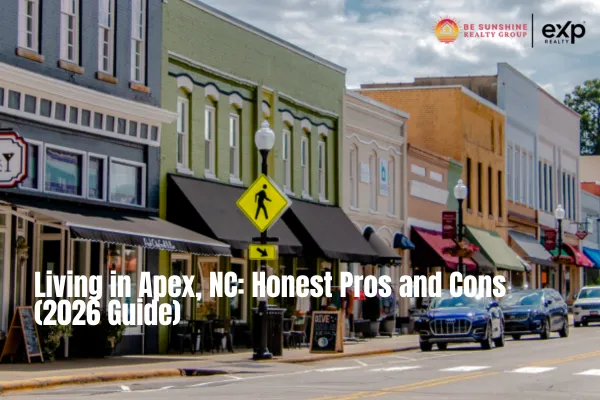
Downtown Apex has preserved historic buildings, locally owned businesses, restaurants, events and community spaces along Salem Street and the surrounding streets.
It gives Apex something that many master-planned communities can't easily manufacture: a sense of place.
You can live in a newer subdivision and still have an established downtown nearby rather than relying entirely on shopping centers and big-box retail.
The catch?
Downtown Apex is popular.
Parking is regulated in several areas, with time limits introduced in 2025 to encourage turnover. The town also maintains a dedicated parking map and app because parking demand is a real consideration.
If you want a quiet, sleepy downtown, Apex isn't always that anymore.
2. There Is a Lot to Do Outdoors
Apex is particularly strong for people who want access to parks, trails and outdoor recreation.
The town currently maintains more than 22 miles of public greenway, including Apex Community Park, Apex Nature Park, Beaver Creek Greenway, Middle Creek Greenway and other connected trail systems.
Apex Community Park is another major draw, with a lake and natural areas that give residents options beyond organized sports and neighborhood amenities.
For families, runners, cyclists, dog owners and anyone who simply wants more opportunities to get outside, this is a meaningful advantage.
And the town is continuing to plan for additional recreation and greenway investment through its long-range parks and recreation plan.
3. The Location Works Well for Triangle Life
Apex's location makes it possible to live in a suburban environment without being isolated from the rest of the Triangle.
Depending on your starting point, you can reach:
Raleigh
Cary
Research Triangle Park
Durham
Chapel Hill
RDU Airport
Major universities
Regional medical centers
The town specifically highlights its proximity to US 1, US 64, I-40 and I-540 as major transportation advantages.
This is particularly useful for households where two people work in different parts of the Triangle.
The catch?
Road access doesn't eliminate traffic.
As Apex has grown, transportation infrastructure has had to keep up. The town is currently planning and studying additional transportation improvements, including the Southeast Connector intended to complete a section of the Apex Peakway loop.
In other words, Apex's location is excellent, but you should test your actual commute before buying.
4. Schools Are a Major Reason Families Look Here
Apex is part of the Wake County Public School System, one of the largest school districts in North Carolina.
The town is served by multiple elementary, middle and high schools, including Apex High School and Apex Friendship High School.
Apex Friendship High, which opened for the 2015–16 school year, had approximately 2,550 students in 2025–26 and offers AP coursework, athletics, clubs and specialized programs.
Apex High likewise offers AP courses, athletics, arts, clubs and career-focused programs.
For families with school-age children, this can be one of the strongest reasons to consider Apex.
But don't buy based on a school name alone.
Wake County uses address-based base-school assignments, and assignments can change as the area grows.
WCPSS specifically directs families to verify the base school for their individual address.
Always check the current assignment for the exact property you are considering.
5. Apex Has a Strong Community Feel
There is a reason people often describe Apex as community-oriented.
The town has a mixture of established neighborhoods, newer developments, recreation programs, local events, parks and a historic downtown.
You don't have to live in an old house near downtown to experience that character. Newer neighborhoods throughout Apex still benefit from being part of a larger town with an established identity.
For buyers who want suburban living but don't want to feel like they live in an anonymous subdivision, Apex can be a strong fit.
6. The Local Economy and Growth Are Strong
Apex is benefiting from the broader growth of the Research Triangle.
The town's population has increased dramatically over the past several decades, and the current development pipeline suggests that growth is far from finished. The town's development projections show the population potentially reaching more than 102,000 by 2030.
A major example is Veridea, a planned 1,100-acre mixed-use development in Apex.
The town describes Veridea as a connected community combining residential, commercial, healthcare, education, retail and employment uses. Phase I is scheduled to progress through 2027, with the overall plan calling for substantial residential and commercial development.
That kind of investment can create jobs, services and new amenities.
It also means Apex is still changing.
The Cons of Living in Apex, NC
1. Apex Is Expensive Compared With Many Other Triangle Options
This is probably the biggest drawback for many buyers.
As of September 2026, Realtor.com reported a median listing price of $579,990 in Apex and a median sold price of $630,700. The median listing price was down 6.95% year over year, while the median sold price was up 8.93%.
That means buyers have more negotiating room in some situations than they did during the hottest housing years, but Apex is still not a bargain market.
Prices also vary dramatically by neighborhood.
For example, recent Realtor.com neighborhood data showed median listing prices ranging from roughly the low-to-mid $400,000s in some areas to $600,000+ in others.
What does this mean for buyers?
You may need to choose between:
More house
A larger lot
A newer home
A better location
A shorter commute
Access to specific amenities
Getting all six may require a substantially higher budget.
2. Rapid Growth Is Changing the Town
Growth is both an advantage and a disadvantage.
Apex has gone from a small community to a town of tens of thousands of residents in a relatively short period.
The Census Bureau recorded a population of 37,476 in 2010 and 58,780 in 2020. The 2025 estimate reached 80,419.
That growth brings:
More restaurants
More shopping
More services
More housing
More employment opportunities
More tax revenue for infrastructure
But it can also mean:
More traffic
More construction
Busier roads
Larger schools
More development pressure
Less open land
If your ideal Apex is a quiet town of 20,000 people, you're already too late.
If you want a growing suburb with increasing investment, that's a different story.
3. Traffic Can Be Frustrating
Apex's location is excellent—but thousands of other people know that too.
Commuters use US 1, US 64, NC 55, NC 540, I-40 and other major roads connecting Apex with Raleigh, Cary, Holly Springs, Durham and RTP.
The town's transportation planning documents reflect the need to address continued growth and connectivity. Projects under consideration include improvements around the Apex Peakway and access to major destinations such as Pleasant Park.
For someone who works remotely, traffic may be a minor issue.
For someone commuting every weekday at 8 a.m. and 5 p.m., it can be one of the most important factors in choosing where within Apex to live.
4. Property Taxes and Utility Costs Matter
Apex is not just expensive because of the purchase price.
Homeowners should also consider property taxes and municipal utility costs.
For fiscal year 2026–27, the Town of Apex adopted a property tax rate of $0.3735 per $100 of assessed value. The town also increased some utility charges, including water, sewer and electricity rates.
The total property-tax picture also includes Wake County taxes, so buyers should calculate the actual tax bill for the property rather than relying only on the town rate.
This becomes especially important when comparing Apex with homes in neighboring communities.
A house that looks only slightly cheaper or more expensive on the listing page can have a noticeably different monthly ownership cost after taxes, HOA fees, insurance and utilities are included.
5. New Construction Isn't Automatically Better
Apex has plenty of newer homes, and that can be attractive.
But new construction often comes with:
Smaller lots
HOA fees
Higher density
Less mature landscaping
Construction activity nearby
Builder-specific layouts
Potentially fewer established trees
Meanwhile, older Apex neighborhoods may offer larger trees, established streets and closer proximity to downtown—but potentially require more maintenance or renovation.
The right choice depends on what you value.
Newer does not automatically mean better.
6. Some Parts of Apex Feel Very Different From Others
This is one of the most important things to understand before buying.
Apex isn't one uniform suburban environment.
You can find:
Historic homes near downtown
Established subdivisions
Larger-lot properties
Newer master-planned communities
Townhomes
Condos
New construction
More rural-feeling areas toward the edges of town
That means saying "I want to live in Apex" isn't specific enough.
Two properties can both have an Apex address and offer completely different lifestyles.
7. Future Development May Change What You Like About Your Neighborhood
The continued development of Apex deserves attention.
Veridea alone represents a major transformation, with the town describing the project as a 1,100-acre mixed-use community with residential, commercial, retail, hospitality, civic and employment components.
That could be fantastic for homeowners who want more amenities and employment nearby.
But if you're buying a property because you love the open land or undeveloped surroundings nearby, check the development plans before assuming they will stay that way.
The Town of Apex maintains development dashboards and maps specifically because the town is changing rapidly.
Is Apex, NC a Good Place to Live?
For many people, yes.
Apex makes particular sense if you want:
Strong access to the Triangle
A suburban environment
A recognizable downtown
Parks and greenways
Access to Wake County schools
A strong local community
Newer housing options
Long-term economic growth
But Apex may be less appealing if your priority is:
Very affordable housing
Minimal traffic
Large lots at moderate prices
A genuinely rural environment
A town that is no longer experiencing rapid development
The biggest question isn't whether Apex is "good."
It's whether Apex is good for the way you actually live.
Who Is Apex Best For?
Families with children
Apex can be particularly appealing for families who prioritize schools, parks, recreation and established community infrastructure.
Triangle professionals
People working in Raleigh, RTP, Cary, Durham or Chapel Hill may find Apex's location useful, provided the commute works for their specific job.
Outdoor enthusiasts
The town's greenways, parks and recreational facilities are a significant advantage.
Buyers planning to stay long term
Someone who expects to live in the Triangle for many years may appreciate Apex's continued investment, population growth and expanding amenities.
Who Might Want to Look Elsewhere?
Buyers on a tight budget
If affordability is your primary concern, neighboring communities may give you more house for the money.
People who hate traffic
Apex's location doesn't protect you from Triangle congestion.
Buyers looking for large acreage
There are larger-lot properties around Apex, but many newer communities offer considerably smaller lots.
People seeking a quiet, slow-growth town
Apex's growth trajectory may work against what you're looking for.
What Should You Know Before Buying in Apex?
Before making an offer on an Apex home, look beyond the listing photos.
Check:
The exact school assignment
Property taxes
HOA fees and restrictions
Future development around the property
Your actual commute during peak hours
Road projects near the neighborhood
Lot size and privacy
Age of the home and major systems
Utility costs
Recent comparable sales
And if you're considering new construction, investigate what is planned around the neighborhood—not just what has already been built.
Frequently Asked Questions About Living in Apex, NC
Is Apex, NC expensive?
Compared with many communities in the region, yes. Realtor.com reported a median listing price of $579,990 in September 2026, although prices vary significantly by neighborhood and property type.
Is Apex a good place for families?
Apex is popular with families because of its Wake County schools, parks, recreation opportunities and suburban environment. However, buyers should always verify the school assignment for the specific address.
Is Apex close to Raleigh?
Yes. Apex is in southwestern Wake County and has access to US 1, US 64, I-40 and I-540. The actual commute to Raleigh depends heavily on your location and traffic conditions.
Does Apex have a downtown?
Yes. Historic downtown Apex is centered around Salem Street and features restaurants, shops, events and preserved historic buildings.
Is Apex still growing?
Very much so. The town's population has increased substantially since 2010, and official projections anticipate continued growth through 2030. Major projects such as Veridea are also adding significant residential and commercial development.
Is Apex a good place to buy a home in 2026?
It can be, particularly for buyers who value location, schools, outdoor amenities and long-term access to the Triangle. But the right purchase depends on price, neighborhood, commute, taxes, HOA costs and future development.
The Bottom Line: Living in Apex in 2026
Apex has earned its reputation for good reasons.
It offers a combination that is difficult to replicate: historic character, suburban housing, strong regional access, parks, schools and continued investment.
But the same growth that makes Apex attractive is also creating some of its biggest challenges.
Housing costs are substantial. Traffic can be frustrating. Development is changing the town quickly. And the Apex you move into today may look noticeably different five or ten years from now.
For buyers, that makes neighborhood-level research especially important.
Instead of asking simply, "Is Apex a good place to live?" ask:
Which part of Apex fits my budget, commute, lifestyle and plans for the next several years?
That is a much better question—and the one that can lead to a much better home purchase.
Brandy Nemergut, Realtor ~ eXp Realty Raleigh, NC
[email protected]
919-583-6895
LivingInRaleighNow.com
