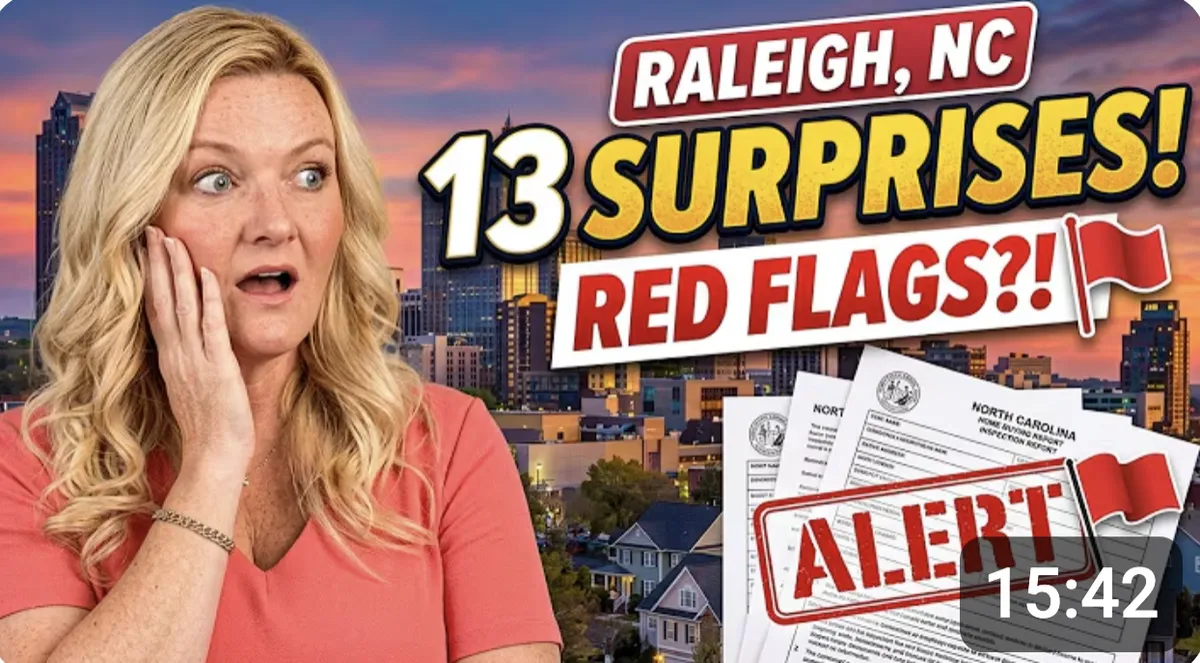
Moving to Raleigh NC? 13 Home Buying SURPRISES (Normal or Red Flag?)
Home Page - Living In Raleigh Now
Buying a home in Raleigh, North Carolina, may be very different from what you're used to. From due diligence fees and home inspections to closing attorneys and local market conditions, understanding how real estate transactions work in North Carolina can help you avoid costly surprises.
If you're relocating to Raleigh, Durham, Cary, Apex, Wake Forest, Clayton, or anywhere in the Research Triangle, there's something important you should know: Buying a home in North Carolina doesn't necessarily work the same way it does in other states.
One of the biggest mistakes relocation buyers make isn't choosing the wrong house. It's assuming the homebuying process will look exactly like it did where they're moving from.
Some differences may seem unusual. Others might feel unfair at first. And a few might leave you wondering, "Wait, is this normal?"
The key is understanding the difference between something that's simply unfamiliar and something that deserves further investigation.
Here are 13 important things every out-of-state buyer should understand before purchasing a home in the Raleigh-Durham Triangle.
1. North Carolina Real Estate Contracts Work Differently
If you've purchased a home in California, New York, New Jersey, Florida, or another state, you may be familiar with separate contingencies for inspections, financing, and appraisals.
North Carolina's standard residential real estate contract takes a different approach.
Instead of relying on the same contingency structure used in many other states, North Carolina commonly uses a due diligence period.
This is a negotiated period during which buyers can investigate the property before deciding whether to proceed with the purchase.
During due diligence, buyers may:
Schedule home inspections and specialized inspections.
Review homeowners association (HOA) documents and restrictions.
Investigate septic systems, wells, and crawlspaces.
Review surveys, property boundaries, and easements.
Verify permits and property improvements.
Work through financing and appraisal requirements.
Evaluate potential repairs and related expenses.
The length of the due diligence period is negotiated between the buyer and seller.
Why this matters: You need enough time to complete your investigations and make informed decisions. Agreeing to an unnecessarily short timeline could leave you without important answers before your due diligence period expires.
2. Due Diligence Fees and Earnest Money Are Not the Same Thing
This is one of the biggest surprises for buyers relocating to North Carolina.
When purchasing a home, you may encounter two separate payments: a due diligence fee and an earnest money deposit.
Although both are associated with your purchase contract, they serve different purposes.
What Is a Due Diligence Fee?
The due diligence fee is a negotiated payment made directly to the seller.
In most circumstances, the fee is nonrefundable, even if the buyer terminates the contract during the due diligence period.
However, the fee is generally credited toward the purchase price at closing.
What Is Earnest Money?
Earnest money is typically held in a trust account by the designated escrow agent.
Depending on the contract terms and when and how the buyer terminates the agreement, earnest money may be refundable.
For example, a buyer who properly terminates during the due diligence period under the standard contract may be entitled to the return of their earnest money deposit.
How Much Due Diligence Money Should You Offer?
There isn't one universal answer.
The appropriate amount depends on the property, competition, current market conditions, and your personal risk tolerance.
Before submitting an offer, make sure you understand exactly how much money you could potentially lose if you decide not to purchase the property.
Winning a bidding war shouldn't mean taking on financial risks you don't understand.
3. Sellers Are Not Automatically Required to Make Inspection Repairs
Imagine receiving a home inspection report that's 80 pages long.
Your first reaction might be, "What have I gotten myself into?"
But here's something important to remember: A lengthy inspection report doesn't necessarily mean you're buying a house with major problems.
Professional inspectors document everything from relatively minor maintenance issues to significant structural or safety concerns.
The important part is understanding which findings deserve the most attention.
Common inspection concerns include:
Foundation or structural issues.
Roof damage or deterioration.
HVAC performance and condition.
Plumbing and electrical problems.
Moisture intrusion and crawlspace concerns.
Safety hazards.
Routine maintenance items.
In North Carolina, sellers are generally not obligated to complete repairs simply because an inspection identifies issues.
Buyers can request repairs, negotiate financial concessions, or decide whether to proceed with the transaction.
The seller may agree to everything, offer a compromise, or decline.
The best approach is to investigate first and negotiate second.
Understanding the severity of an issue, the approximate repair cost, and your contractual deadlines can help you make a practical decision rather than an emotional one.
4. Finding a Problem Doesn't Automatically Mean the Seller Hid It
Sometimes an inspection reveals an issue that surprises everyone.
When that happens, buyers may immediately suspect the seller knew about the problem and deliberately failed to disclose it.
That's possible in some situations, but it shouldn't be the automatic assumption.
Many homeowners don't regularly inspect their crawlspaces, attics, foundations, or every component of their home's mechanical systems.
North Carolina also has specific residential property disclosure requirements, but seller disclosures are not warranties guaranteeing that a property is free of defects.
If an unexpected problem is discovered, the smartest approach is to gather more information.
Determine the nature of the issue, consult the appropriate professionals, and evaluate your available options.
A discovered defect deserves attention, but it doesn't automatically establish that someone acted dishonestly.
5. North Carolina Is an Attorney Closing State
Another major difference for relocation buyers is how closings are handled.
North Carolina is an attorney closing state, meaning a licensed North Carolina attorney performs the legal services associated with a residential real estate closing.
The closing attorney's responsibilities commonly include:
Conducting or reviewing title examinations.
Preparing or supervising legal closing documents.
Addressing legal title matters.
Coordinating the legal aspects of settlement.
Handling deed recording and other required closing procedures.
This may differ significantly from the process you're familiar with in another state.
Buyers coming from states where each party commonly hires a separate attorney may find North Carolina's closing structure unfamiliar.
Importantly, the closing attorney does not automatically serve as your personal legal advocate on every issue involved in the purchase.
Buyers can seek independent legal counsel whenever necessary.
This is particularly worth considering when purchasing new construction because builder contracts often contain provisions designed to protect the builder's interests.
Different closing procedures don't automatically mean something is wrong, but understanding everyone's role is essential.
6. Don't Assume Your Previous Housing Market's Negotiation Strategies Will Work in Raleigh
One of the most common relocation mistakes is assuming a negotiation strategy that worked in another state will also work in North Carolina.
For example, a buyer relocating from a slower market might be accustomed to offering significantly below asking price.
That strategy could work on certain Raleigh-area properties, but it could also cost you the home you want.
The Raleigh-Durham Triangle isn't one uniform real estate market.
It's a collection of smaller markets, each influenced by location, home type, price range, inventory, and buyer demand.
A move-in-ready home in Cary may attract substantial interest, while another property nearby could remain available for several weeks.
One Wake Forest neighborhood may have limited inventory, while a Raleigh neighborhood may offer buyers more opportunities to negotiate.
New construction communities can differ just as dramatically, with some builders offering substantial incentives while others have less flexibility.
Before determining an offer strategy, evaluate:
Recent comparable home sales.
Current competing listings.
Days on market.
Property condition and needed improvements.
Previous price reductions.
Local supply and demand.
Seller motivation, when available.
Your offer should be based on the specific property you're purchasing, not assumptions about the entire Raleigh market.
7. A Home Sitting on the Market for 60 Days Isn't Automatically a Red Flag
Remember the housing market of 2021?
Homes sometimes received multiple offers within days, and buyers had to make decisions quickly.
Market conditions have changed since then, and homes in some price ranges and locations may now take longer to sell.
If you find a property that's been listed for 30, 60, or even 90 days, don't automatically assume there's something wrong with it.
There are several possible explanations.
The home may have been priced too aggressively when first listed. Its floor plan might appeal to a smaller group of buyers. Its location may not work for everyone, or the home may simply need someone with the right priorities.
Sometimes a property loses momentum after entering the market above its competitive price range.
Rather than dismissing the property, investigate its history.
Look at previous listing activity, price adjustments, comparable sales, inspection findings, and disclosures.
A longer time on market can sometimes create an opportunity for buyers who understand the property's value.
8. Raleigh Is More Balanced Than the Frenzied Market of 2021, but Every Property Is Different
Many relocation buyers want to know whether Raleigh is currently a buyer's market or a seller's market.
The answer isn't necessarily the same across the entire region.
Compared with the intense competition seen during the pandemic-era housing boom, many market segments have become more balanced.
However, that doesn't mean buyers automatically control every negotiation.
An updated home in a desirable location, priced competitively, may still attract significant interest.
Meanwhile, a property needing substantial repairs or sitting above market value may offer much greater negotiating flexibility.
Even neighboring communities can experience different levels of demand.
This is why it's important to look beyond broad headlines about the Raleigh housing market.
Whether you're considering Cary, Apex, Holly Springs, Garner, Clayton, Wendell, Rolesville, or Wake Forest, your strategy should reflect what's happening in that particular neighborhood and price range.
There isn't just one Raleigh real estate market. There are many markets within the market.
9. Homes in North Carolina May Have Features You're Not Used To
Depending on where you're moving from, some North Carolina property features may be completely new to you.
Crawlspaces, septic systems, private wells, propane tanks, private roads, and HOA architectural restrictions are relatively common in parts of the Triangle.
None of these features automatically make a home undesirable.
They do, however, require additional research.
Crawlspaces
Many North Carolina homes have crawlspace foundations.
Moisture management is an important consideration, so buyers should understand the condition of the crawlspace, signs of water intrusion, and any existing moisture-control systems.
Septic Systems
If a home uses a septic system, investigate its permit, capacity, condition, and approved repair area.
For example, the number of bedrooms supported by the septic permit may matter when you're considering renovations or future additions.
Private Wells
For properties served by a private well, buyers should consider water quality testing, well performance, and maintenance responsibilities.
Private Roads
If access to a property is provided by a private road, find out who maintains it and whether formal maintenance agreements exist.
HOA Restrictions
Homeowners associations may regulate fences, exterior modifications, outbuildings, parking, or other property uses.
This can be particularly important if you're moving to North Carolina for more land, privacy, or flexibility.
The takeaway is simple: Unfamiliar features aren't necessarily problems, but they shouldn't be overlooked.
10. Don't Assume You'll Automatically Receive a New Property Survey
In some states, buyers may be accustomed to receiving a new survey as a standard part of the homebuying process.
That's not something you should automatically expect in North Carolina.
Depending on the property and your plans, obtaining a new survey may be a worthwhile investment.
A survey can help identify matters such as:
Property boundaries.
Fence locations.
Easements.
Potential encroachments.
Setbacks and improvement locations.
Issues that could affect future construction.
This may be especially important if you're planning to install a fence, add a pool, build a detached garage, or make other improvements.
Discuss whether a survey is appropriate early in the transaction so there's sufficient time to address potential concerns.
11. Signing Your Closing Documents Doesn't Necessarily Mean You Get the Keys Immediately
This is a North Carolina closing detail that catches some out-of-state buyers by surprise.
You may have a settlement appointment scheduled for 9:00 a.m., sign the required documents, and expect to receive your keys immediately.
However, signing the paperwork isn't necessarily the same as legally completing the closing.
Under North Carolina's standard residential purchase contract, closing occurs when the deed is recorded.
That means there can be a gap between signing your documents and the official completion of your purchase.
Recording may happen later that day, depending on funding, document processing, and the county register of deeds.
For relocation buyers coordinating movers, deliveries, utilities, and travel arrangements, this distinction matters.
Avoid scheduling a moving truck to arrive immediately after your settlement appointment unless the timing has been carefully coordinated.
Your real estate agent and closing attorney can help you understand the expected process and when possession is permitted under your contract.
12. Don't Expect Your New Home to Be Professionally Cleaned Unless It Was Negotiated
Final walkthrough day can be exciting, but it may also reveal things you didn't notice during previous showings.
Once the seller removes furniture, rugs, and decorations, you might discover scuff marks, dust, or other signs of everyday use.
While sellers have contractual obligations regarding property condition and removal of personal belongings and debris, a professional cleaning service is not automatically included in every North Carolina home sale.
If professional cleaning is important to you, discuss it during negotiations rather than assuming it will be provided.
Otherwise, consider arranging a cleaning service before moving your furniture into the property.
Starting fresh in a clean home can make moving day significantly more enjoyable.
13. Smart Negotiation Doesn't Have to Mean Conflict
Buying a home is a major financial decision, and emotions can sometimes run high.
When inspections uncover issues or negotiations become difficult, it's easy to assume the other side is being unreasonable.
But turning every disagreement into a confrontation doesn't necessarily produce better results.
Effective real estate negotiation is about understanding your priorities, evaluating your options, and choosing a strategy that supports your goals.
Sometimes that requires a firm position.
Sometimes it means allowing the seller time to consider a reasonable request.
And sometimes the right decision is recognizing when a deal no longer makes sense.
The goal isn't to create unnecessary conflict. It's to protect your interests while keeping the transaction moving toward a successful outcome whenever possible.
An experienced buyer's agent can help you distinguish between issues worth negotiating, concerns that require further investigation, and situations where walking away may be the best choice.
Different Doesn't Mean Wrong, but It Doesn't Mean You Should Ignore Red Flags
If there's one thing to remember when buying a home in North Carolina, it's this:
Just because something works differently here doesn't automatically mean there's a problem.
Due diligence fees may be unfamiliar. Closing attorneys may have different responsibilities than you're used to. Sellers may decline repair requests. Properties may have crawlspaces, wells, or septic systems. And you may not receive your keys immediately after signing.
These can all be normal parts of buying a home in North Carolina.
But there's an equally important side to that advice.
Never dismiss a legitimate concern simply because someone tells you, "That's just how we do things here."
A knowledgeable real estate agent should help you understand the process, investigate potential problems, and make informed decisions.
The goal isn't to blindly trust every step.
It's to understand what you're agreeing to and why.
Relocating to Raleigh, NC? You Don't Have to Figure Everything Out Alone
Moving to a new state involves more than finding the right house.
You also need to understand the communities, local housing market, commute patterns, property features, and how the buying process works.
And when you're relocating from hundreds or thousands of miles away, that can feel overwhelming.
I understand that experience personally.
My family and I moved to North Carolina from Southern California without seeing it first. I know what it's like to research unfamiliar towns, compare neighborhoods, and wonder whether you're asking the right questions.
Today, I help buyers and families relocating to Raleigh and the surrounding Triangle communities navigate those same decisions with greater clarity and confidence.
Whether you're considering Raleigh, Durham, Chapel Hill, Cary, Apex, Holly Springs, Wake Forest, Clayton, Knightdale, Wendell, or another nearby community, choosing the right location is just as important as understanding how to purchase the home.
If you're planning a move, start by identifying your budget, where you'll be working, your preferred lifestyle, and the features that matter most in your next home.
Those details can help narrow down which Triangle communities make sense for you.
And having an experienced local Realtor guiding the process can help you avoid surprises before they become expensive problems.
Ready to explore homes in the Raleigh-Durham Triangle?
Visit LivingInRaleighNow.com to learn more about the area, explore communities, and connect with a local real estate professional who understands the relocation process.
You can also explore my YouTube channel, Life in Raleigh NC, for helpful videos about Raleigh-area neighborhoods, homebuying, new construction, and everyday life in the Triangle.
Frequently Asked Questions About Buying a Home in Raleigh, North Carolina
Is buying a home in North Carolina different from other states?
Yes. North Carolina uses a due diligence process, commonly involves negotiated due diligence fees and earnest money deposits, and requires an attorney to perform the legal closing work. These differences can be especially important for relocation buyers.
Is due diligence money refundable in North Carolina?
Generally, a due diligence fee is nonrefundable unless the contract or specific legal circumstances provide otherwise. Buyers should understand the amount at risk before making an offer.
Can I cancel a home purchase during due diligence?
Under the standard North Carolina residential purchase contract, buyers generally have the right to terminate during the due diligence period by providing the required notice before the deadline. The due diligence fee is ordinarily forfeited, while earnest money is generally refundable following proper termination.
Does the seller have to fix problems found during a home inspection?
Generally, no. Sellers are not automatically required to repair inspection findings. Buyers can negotiate repairs or concessions, but the seller may decline.
Do I need a real estate attorney to buy a home in Raleigh?
North Carolina requires a licensed attorney to handle the legal work associated with closing. Buyers may also choose to obtain independent legal advice for specific contractual or property concerns.
Is Raleigh a buyer's market or seller's market?
Conditions vary by community, property type, price range, and inventory. Some properties may attract multiple offers, while others provide buyers with greater negotiation opportunities. Current local market data is essential.
Do I automatically get a property survey when buying in North Carolina?
No. Buyers shouldn't assume a new property survey will automatically be provided. Depending on the property and future plans, commissioning a survey may be advisable.
When do I receive the keys after closing in North Carolina?
Under the standard purchase contract, closing occurs when the deed is recorded. Possession is governed by the contract, so signing settlement documents does not necessarily mean you can immediately move into the property.
Brandy Nemergut, Broker-Realtor®
Be Sunshine Realty Group | eXp Realty
Raleigh-Durham, North Carolina
Phone: 919-583-6895
Email: [email protected]
Website: LivingInRaleighNow.com
YouTube: Life in Raleigh NC
Love where you live!
Disclaimer: This article is for general educational purposes only and is not legal, tax, or financial advice. Real estate contract terms, market conditions, and individual circumstances vary. Consult a licensed North Carolina real estate attorney and appropriate professionals regarding your specific transaction.
Lance Nemergut Realtor ~ eXp Realty of Triangle NC
Brandy Nemergut, Realtor ~ eXp Realty Raleigh, NC
[email protected]
919-583-6895
LivingInRaleighNow.com
