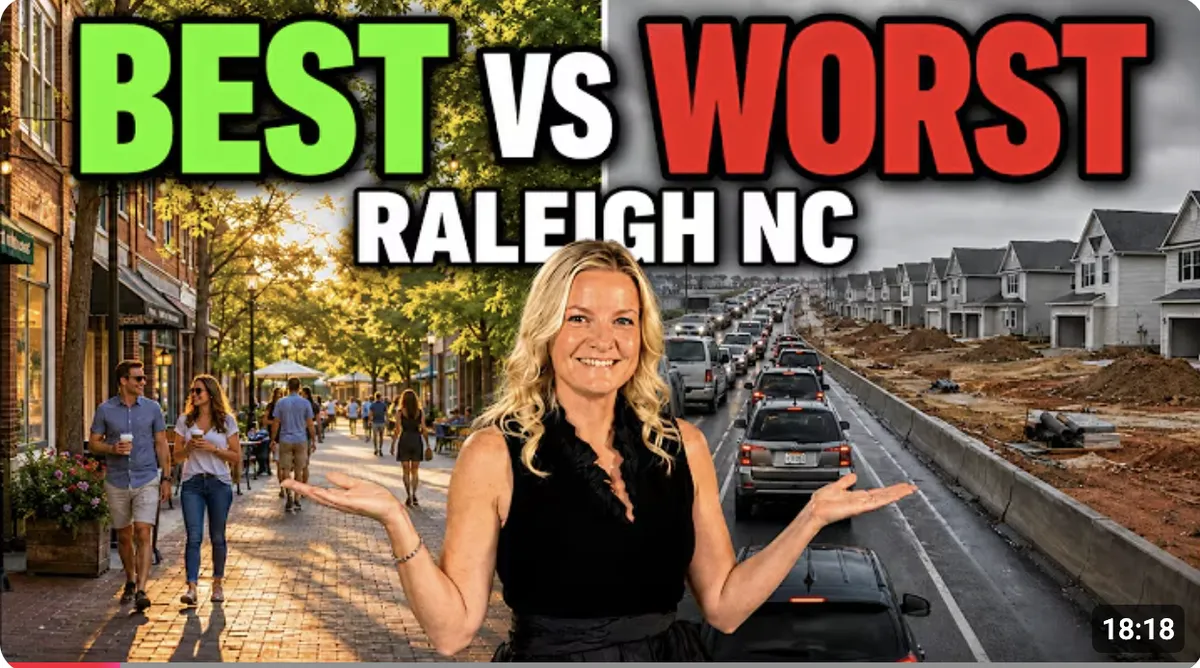
The TRUTH About Moving to Raleigh: Best and Worst Towns!
Home Page - Living In Raleigh Now
Picking the wrong Raleigh suburb can cost you a lot more than money.
You can find the perfect house, get the space you wanted, love the neighborhood—and then realize your commute is miserable, everything you actually do is on the other side of the Triangle, and you probably should have looked 20 minutes in a different direction.
And there’s another challenge: some of the Raleigh suburbs everyone talks about come with a pretty serious price tag, while a few of the less obvious choices may give you more house, easier access to Raleigh, or a lifestyle that simply fits you better.
So, I’m ranking nine Raleigh-area suburbs and towns from those with the biggest tradeoffs to the ones I think offer the strongest overall package.
Will everyone agree with my rankings? Absolutely not.
And that’s exactly the point.
There is no single “best suburb of Raleigh” for everyone.
If you work from home, your list may look completely different from someone commuting to Research Triangle Park every day. If Downtown Raleigh is where you need to be regularly, that changes the equation again.
My family and I relocated to the Raleigh area from Southern California eight years ago, so I remember what it feels like to stare at a map of the Triangle from another state wondering, Where am I actually supposed to live?
That’s why I always tell people to figure out their daily triangle before falling in love with a house.
Where do you work? Where will you spend most of your time? What do you want five or ten minutes from home?
Because the house matters, obviously. But if everything you enjoy doing is 45 minutes away, that beautiful house may start losing its sparkle pretty quickly.
With that in mind, let’s get into the rankings.
#9: Louisburg and Franklinton
I’m grouping Louisburg and Franklinton together because they offer many of the same advantages—and many of the same tradeoffs.
To be clear, these are not bad places to live. They simply make the most sense for a more specific type of buyer.
The biggest advantage is value.
Your money can stretch farther here, particularly if you’re looking for newer construction, more space, or a quieter lifestyle without paying Wake County prices.
If you work remotely or don’t need to be in Raleigh every day, that can be a very worthwhile trade.
The catch is distance.
If you’re commuting regularly to Raleigh, RTP, or RDU Airport, that drive becomes part of your everyday life. A 45-minute commute sounds pretty reasonable while you’re house hunting on a Sunday afternoon. It feels a little different Monday morning when you’ve listened to so many podcasts you’re basically earning college credits.
You’ll also find fewer shopping and dining options than you would in some of the larger Raleigh suburbs, which means you may find yourself heading toward Wake Forest fairly often.
Another thing to consider is what you really mean when you say you want a “rural” lifestyle.
Some buyers picture mature trees, acreage, privacy, and lots of open space. Then they arrive at a brand-new subdivision where the trees are gone and 300 houses just appeared.
There’s nothing inherently wrong with that—it just may not be the type of country living you had pictured.
Best for: Buyers prioritizing affordability, newer construction, space, and a quieter lifestyle over convenience to Raleigh and RTP.
#8: Clayton and Johnston County
Clayton is my anchor here because Johnston County is huge.
Clayton, Smithfield, Four Oaks, Benson, Selma, and the smaller communities farther out can offer very different lifestyles. But there’s one major reason buyers continue looking southeast of Raleigh:
More house for the money.
Depending on where you buy, you may be able to get newer construction, more square footage, or a larger lot for considerably less than you would in many parts of Wake County.
Clayton itself has changed tremendously.
There’s more shopping, dining, healthcare, employment, and development than there was even a few years ago. This definitely isn’t the Johnston County of 15 years ago.
The biggest consideration for many buyers is still the commute.
The farther south or east you go, the more important it becomes to test-drive your commute during the actual hours you’ll be making it.
Living in Clayton and commuting to Downtown Raleigh can make sense for many people.
Living farther into Johnston County while commuting to RTP five days a week?
That’s an entirely different conversation.
Best for: Buyers who want newer homes, more breathing room, and better value and are comfortable trading some proximity for it.
#7: Knightdale
Knightdale tends to get overlooked by relocation buyers because they hear Cary, Apex, and Wake Forest approximately 4,000 times before anyone mentions it.
But Knightdale has one major advantage:
It’s close to Raleigh.
With I-87 and I-540 nearby, getting into Downtown Raleigh can be surprisingly convenient depending on where you live.
Housing prices can also be more approachable than Cary and many parts of Raleigh.
Knightdale Station Park, greenway connections, sports fields, and continued development around town give residents plenty to do without traveling far.
The tradeoff is that Knightdale doesn’t have the same polished town-center feel you’ll find in places like Cary or Apex, and the dining scene still leans more heavily toward chains.
But if your priorities are a solid home, convenient Raleigh access, and a Wake County location without Western Wake County pricing, Knightdale deserves a serious look.
I sometimes think of Knightdale as the Toyota Camry of Raleigh suburbs.
Maybe it isn’t the one everyone is showing off, but eventually you realize it was actually a pretty smart decision.
Best for: Buyers wanting Wake County, easier Raleigh access, and more attainable housing prices.
#6: Wendell
Wendell has changed so much that if someone is giving you their opinion based on what the town looked like 10 years ago, they probably need an update.
And of course, Wendell Falls is a huge part of that growth.
What Wendell Falls does especially well is combine newer construction with a master-planned community lifestyle without feeling like someone simply dropped hundreds of houses into a field and called it a neighborhood.
You have Treelight Square, restaurants, Publix, parks, trails, pools, and community events. Depending on where you live within the community, you may even be able to walk or bike to certain amenities.
Around Raleigh, that’s worth pointing out because sometimes “walkable” means you technically can walk there—as long as you pack water and tell your family where you’re going.
Historic Downtown Wendell also gives the town personality beyond Wendell Falls.
That combination of newer amenities and older small-town character is one of Wendell’s biggest strengths.
The downside is growth.
When a town grows quickly, roads and infrastructure have to catch up. And if you’re commuting regularly to RTP or RDU, Wendell probably wouldn’t be near the top of my list if spending 30 to 45 minutes in the car isn’t something you want to do.
Another consideration in Wendell Falls is resale competition.
If you buy new construction and need to sell again within a year or two, you could find yourself competing against a builder offering brand-new homes and incentives right down the street.
That doesn’t mean you shouldn’t buy there. It simply means I would think longer-term.
Best for: Buyers looking for newer construction, strong community amenities, and better value than many Western Wake County suburbs—especially when their daily life keeps them on the eastern side of the Triangle.
#5: Garner
Garner is one of my sleeper picks because people tend to underestimate it.
They drive through one section of Garner and decide they’ve seen the town.
You haven’t.
Garner offers everything from established neighborhoods with mature trees to newer subdivisions, townhomes, and larger properties farther outside the center of town.
Its biggest advantage is location.
There are parts of Garner where getting into Downtown Raleigh can actually be easier than trying to cross Raleigh from one side of the city to the other at the wrong time.
You also have Lake Benson, White Deer Park, continued redevelopment around Downtown Garner, and the advantage of being close enough to Raleigh that you don’t feel isolated.
For buyers who want suburban living, convenient access to Raleigh, and more value than they may find in the western suburbs, Garner deserves much more attention than it sometimes gets.
And if mature trees and established neighborhoods matter to you, Garner offers more choices than some of the Triangle’s brand-new boomtowns.
Best for: Buyers wanting convenience to Raleigh, established neighborhoods, suburban living, and good overall value.
#4: Apex
Now we’re getting into the premium Western Wake County options.
Apex is one of the most important towns for relocation buyers to understand because people sometimes still describe it as the affordable alternative to Cary.
That really isn’t the story anymore.
Apex has grown up—and so have the prices.
What Apex does offer is a strong combination of historic charm, established neighborhoods, newer construction, parks, restaurants, and convenient access to the western side of the Triangle.
Downtown Apex along Salem Street has local restaurants, shops, and the older Main Street atmosphere many people imagine when they say they want a charming downtown.
Then you have newer areas of Apex that feel completely different.
Recreation is another big plus. Apex Community Park and Pleasant Park give residents access to athletic fields, pickleball, tennis, basketball, playgrounds, and other recreational amenities.
Depending on which side of Apex you choose, you can also have fairly convenient access to Cary, RTP, and the I-540 corridor.
But that brings up an important point:
There isn’t just one Apex.
Historic Downtown Apex feels completely different from many of the newer developments farther west and south.
Instead of simply asking, “Should I move to Apex?” I’d want to know which Apex actually fits your lifestyle.
Best for: Buyers who want Cary-like convenience with more historic small-town character and access to Western Wake County.
#3: Morrisville
Morrisville’s superpower is simple:
Convenience.
If Morrisville had a dating profile, it would basically say, “Close to everything.”
RTP? Close.
RDU Airport? Close.
Cary? Close.
Raleigh and Durham? Convenient access to both.
If you travel frequently, work in tech, work in or around RTP, or simply move around the Triangle all day, Morrisville can make everyday life dramatically easier.
And that matters much more than people realize before moving here.
Because around the Triangle, 10 miles and 10 minutes are absolutely not the same thing.
Morrisville also offers shopping, parks, greenways, and an impressive variety of international restaurants.
The downside is that you pay for the convenience.
Some neighborhoods may also feel newer or more cookie-cutter compared with communities that developed around an older downtown.
Morrisville didn’t grow around a historic Main Street with string lights and people wandering around eating ice cream. It grew because people needed convenient access to jobs, highways, RTP, and the airport.
If charm is your top priority, there may be better choices.
But if your question is, Where can I live that makes the rest of my life easier?
Morrisville is very hard to beat.
Best for: Frequent travelers, RTP commuters, tech workers, and buyers prioritizing convenience above small-town charm.
#2: Cary
Yes, Cary is number two.
I can already hear some Cary residents asking why it isn’t number one.
And to be fair, Cary probably is number one in plenty of categories.
It’s established and centrally located, with restaurants, shopping, parks, greenways, older neighborhoods, newer neighborhoods, townhomes, luxury homes, and relatively easy access to Raleigh, RTP, and RDU.
Cary basically looked at the suburban checklist and said, “Fine, we’ll do it all.”
Downtown Cary Park has also transformed the downtown area into a genuine destination, with events, restaurants, gathering spaces, and places where people actually want to spend time.
Cary’s extensive greenway system is another major advantage.
The catch?
Price.
Everybody already knows Cary is desirable.
And when everybody wants the same thing, prices tend to notice.
You’re paying a premium to live here.
For some buyers, that premium is absolutely worth it.
But Cary is also a large town, and location within Cary matters considerably. Downtown Cary feels different from West Cary. West Cary feels different from Southeast Cary.
Your commute, neighborhood feel, housing options, and everyday lifestyle can vary significantly depending on where you buy.
Best for: Buyers whose budget supports it and who want convenience, amenities, an established suburban environment, and central Triangle access.
#1: Wake Forest
My number one Raleigh suburb is Wake Forest.
Why?
Because I think Wake Forest offers one of the strongest overall combinations of housing options, amenities, character, and community lifestyle without making you feel like you have to drive into Raleigh every time you want something to do.
That’s why it takes the top spot.
Not because it has the best commute—it doesn’t.
Not because it’s the cheapest—it isn’t.
It wins because of the overall package.
Wake Forest has an actual historic downtown with restaurants, breweries, shops, and events.
White Street has personality. Friday Night on White brings residents downtown for live music and community events.
You also have Joyner Park, greenways, Falls Lake nearby, and plenty of recreational opportunities.
Housing options range from established communities like Heritage to newer developments like Holding Village, along with plenty of neighborhoods in between.
And yes, there’s a Wegmans.
We’re counting it.
People have made major life decisions based on less.
What really separates Wake Forest from some of the other rapidly growing Raleigh suburbs is that it already functions like its own town.
You can eat there, shop there, attend events there, and spend an entire Saturday there without constantly feeling like you need to head into Raleigh for entertainment.
The downside is the commute.
Wake Forest sits northeast of Raleigh, while RTP and RDU Airport are farther west.
If you’re commuting to RTP five days a week or flying constantly, Wake Forest would drop considerably lower on my personal ranking.
But if you work remotely, work in North Raleigh or northeast Wake County, or are willing to trade some commute time for a more self-contained community lifestyle, Wake Forest is incredibly compelling.
Best for: Buyers who want amenities, character, a strong community feel, diverse housing choices, and a town that can stand on its own.
What About Durham?
Before someone asks, “Wait—where’s Durham?”
I didn’t forget it.
I left Durham out of this ranking because Durham really isn’t a Raleigh suburb.
It’s its own city with its own downtown, universities, major employers, restaurants, arts, entertainment, and identity.
If you work at Duke, Duke Health, or RTP—or you want more of a true city environment with a little more personality and edge—Durham absolutely belongs in your relocation conversation.
It simply deserves to be compared as Durham, rather than squeezed into a ranking of Raleigh suburbs.
So, What Is the Best Raleigh Suburb?
That depends entirely on you.
Please don’t choose where you live because a town came first on somebody’s internet ranking—including mine.
Use rankings like this to narrow your options, and then look at your actual lifestyle.
Ask yourself:
Where will I be working?
What do I want my weekends to look like?
What do I want within five or ten minutes of my house?
How much driving am I genuinely willing to do?
Do I value newer construction, mature neighborhoods, walkability, convenience, space, or amenities most?
Am I willing to pay more for location?
Because I can find you a beautiful home almost anywhere around the Triangle.
But if you love the house and hate where it is, eventually you’re probably going to start blaming the house.
And that poor little house didn’t do anything.
Moving to Raleigh? Let’s Find the Area That Fits You
If you’re trying to figure out where you fit in Raleigh and the surrounding Triangle area, this is exactly what I help people do.
Whether you’re moving here from across the country, moving across town, or realizing the place you live now simply doesn’t fit your lifestyle anymore, reach out to me.
Tell me what matters most to you, and I’ll help you narrow down the communities that actually make sense for the way you want to live—not just the ones that look good on a ranking.
And if you’re still in the research stage, grab a free copy of our Ultimate Raleigh Relocation Guide and continue exploring Raleigh, Cary, Apex, Wake Forest, Clayton, Garner, Knightdale, Wendell, Morrisville, and the rest of the Triangle.
The right suburb isn’t necessarily the one everybody else says is best.
It’s the one that makes your everyday life better.
Brandy Nemergut, Realtor ~ eXp Realty Raleigh, NC
[email protected]
919-583-6895
LivingInRaleighNow.com
