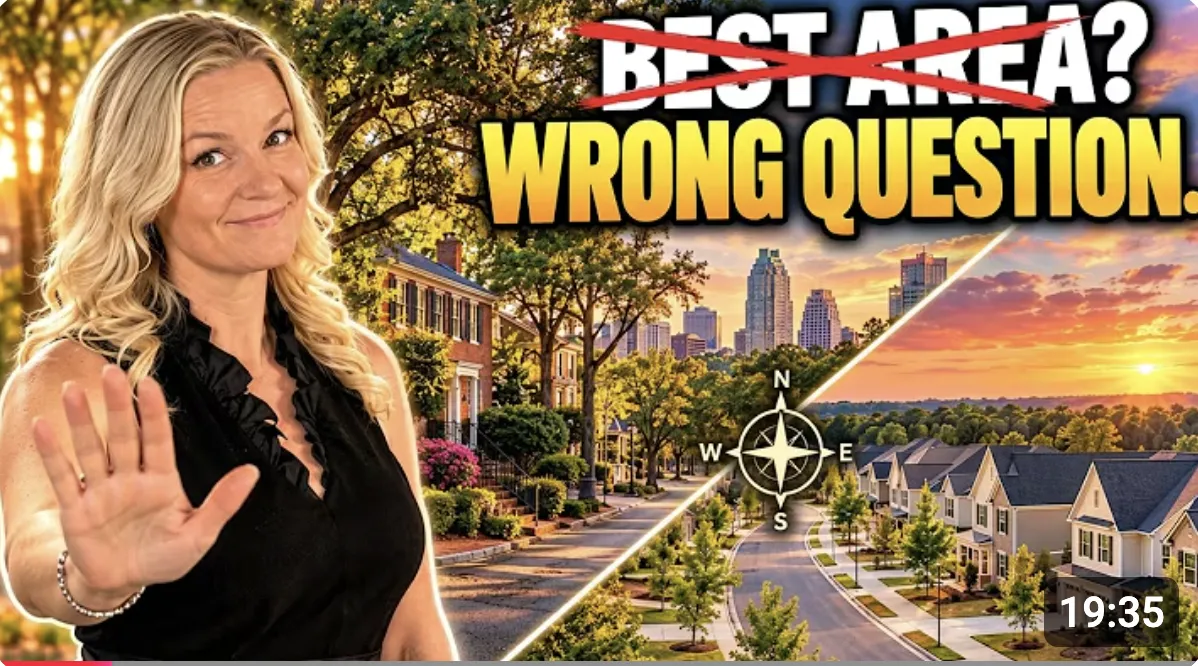
Where Should You Live in Raleigh? A Local Guide to the 6 Major Areas
Home Page - Living In Raleigh Now
Where Should You Live in Raleigh? A Local Guide to the 6 Major Areas
One of the first questions people ask when they’re considering a move to Raleigh is:
“Which area is the best?”
But there’s actually a much better question to ask:
Which area is going to fit my life best?
Because two places that look almost identical when you’re scrolling through homes online can give you completely different lifestyles once you actually live here.
Your commute, monthly housing costs, how much house you can get for your money, proximity to restaurants and shopping, access to the airport, and even whether your neighborhood feels historic and established or brand-new can change dramatically depending on which direction you go.
And that’s exactly why figuring out where to live in the Raleigh area can feel overwhelming.
Instead of giving relocation buyers a giant list of neighborhoods, I like to break the Raleigh area into six general zones. Each one offers different advantages, trade-offs, housing styles, price points, and lifestyles.
So, think of this as the conversation we would have if we were sitting down together trying to figure out where your life actually fits.
One important note before we get started: if schools are an important part of your decision, always verify the exact property address. In Wake County, school assignments, calendars, enrollment caps, and other factors can sometimes vary even between homes that appear to be in the same general area.
Now, let’s explore Raleigh.
1. Central Raleigh and Inside the Beltline
One of the best places to start is right in the middle of Raleigh.
When locals say “Inside the Beltline,” they’re generally referring to the neighborhoods inside I-440 surrounding downtown Raleigh.
But even within this relatively small area, you’ll find two very different lifestyles.
Downtown Raleigh
If you want to be close to restaurants, bars, entertainment, museums, parks, and events, downtown Raleigh offers one of the most urban lifestyles in the Triangle.
You’ll find condos and apartments throughout downtown, and while Raleigh overall remains a fairly car-dependent city, downtown is one of the places where you can realistically park the car and walk to dinner, drinks, a concert, or an event.
Downtown pricing can be difficult to summarize with one median number because the housing market includes everything from smaller condos to multimillion-dollar luxury properties.
One area where buyers may sometimes find more negotiating room is the condo market.
But there’s an important catch:
HOA dues.
Depending on the building and its amenities, condo fees can easily run several hundred dollars per month and sometimes considerably more.
That means you shouldn’t compare a $450,000 condo with a $550,000 single-family home using purchase price alone.
Compare the total monthly cost:
Mortgage.
Property taxes.
Homeowners insurance.
HOA dues.
Parking.
Because sometimes the cheaper house isn’t actually the cheaper house.
Raleigh’s Historic and Established Neighborhoods
Move outside the downtown core and Raleigh changes quickly.
This is where you’ll find historic neighborhoods such as Oakwood, Boylan Heights, and Mordecai, along with established areas including Five Points, Hayes Barton, Budleigh, and Fallon Park.
This is also where Raleigh really earns its nickname, the City of Oaks.
Think mature trees, older architecture, front porches, winding streets, and neighborhoods that feel like they’ve been here awhile—because they have.
Take a drive through Hayes Barton or along Wake Drive and you’ll quickly understand why people are willing to pay a premium to live in this part of Raleigh.
And yes, Raleigh takes the oak tree theme seriously.
We literally lower a giant copper-and-steel acorn downtown on New Year’s Eve.
We commit to the theme.
The housing here can be a little tricky, though.
You might see a beautifully renovated historic home selling well into seven figures—and a few streets away find an older property where much of what you’re really buying is the location, lot, and opportunity to renovate.
You’re also buying older housing stock.
That can mean older plumbing and electrical systems, crawl spaces, smaller closets, and occasionally a floor plan that makes you wonder exactly what people were doing in 1947.
From downtown Raleigh, RTP can generally be around a 25- to 35-minute drive depending on traffic and exactly where you’re going.
But here’s my rule with any commute in the Triangle:
Drive it when you would actually be driving it.
Not Sunday morning at 10:00.
Try Tuesday at 8:00 a.m.
That’s the commute we care about.
Who Central Raleigh May Work Well For
Central Raleigh may be worth exploring if you prioritize:
Character and older architecture
Proximity to downtown
Mature neighborhoods
Restaurants and entertainment
Greater walkability
Established surroundings
The trade-off is that you’re often paying a premium for the location while purchasing an older home.
2. West Raleigh, Cary, and Morrisville
If your daily life takes you west toward Research Triangle Park, Cary, Morrisville, or RDU Airport, the western side of the Triangle deserves serious consideration.
Cary existed long before Research Triangle Park, but RTP played a major role in shaping Cary and Morrisville into what they are today.
As RTP grew into one of the region’s major employment centers, both towns became increasingly desirable because of their location.
As of summer 2026, Cary’s median sales price was approximately $645,000, while Morrisville was closer to $560,000.
But those averages hide a huge variety of housing.
Cary includes everything from condos and townhomes at lower price points to established homes in central Cary, newer communities in West Cary, and luxury properties selling well above $1 million.
And West Cary can feel completely different from Downtown Cary.
Downtown Cary
Downtown Cary has undergone an impressive transformation.
Today, you’ll find Downtown Cary Park, restaurants, breweries, shops, and community events—all surrounded by established neighborhoods.
Farther west, you’re more likely to find newer master-planned communities and easier access to RTP.
Morrisville
Morrisville takes the convenience factor even further.
It sits between Cary, RTP, and RDU International Airport, making it extremely convenient for people who regularly commute to RTP or travel frequently.
The trade-off?
You’re paying for that convenience.
Lots can be smaller, major roads can become busy, and depending on the specific location, it’s worth paying attention to the RDU flight paths.
West Raleigh
West Raleigh has yet another personality, particularly around NC State University and Hillsborough Street.
Here you’ll find older neighborhoods, rental properties, student housing, and considerably more university influence.
This entire western zone may work especially well for buyers who prioritize:
RTP access
Airport access
Convenience
Employment centers
Shopping and amenities
The major things to watch are price, traffic, and understanding exactly which pocket you’re purchasing in.
3. Apex and Holly Springs
If you like the western side of the Triangle but want newer housing and are willing to go farther south, Apex and Holly Springs often enter the conversation.
As of summer 2026, Apex had a median sales price of roughly $622,000, while Holly Springs was around $630,000.
Apex
Apex offers a great combination of established neighborhoods, newer construction, and a charming historic downtown.
Downtown Apex has restaurants, shops, events, and historic buildings, giving the town a little more personality than you might expect from a rapidly growing suburb.
Holly Springs
Holly Springs feels newer overall, and it’s becoming much more than simply a bedroom community for Raleigh and RTP.
UNC Health Rex opened its Holly Springs hospital in 2021, and the town has attracted major life-sciences investments from companies including Fujifilm and Amgen.
That means you’re not only seeing houses being built—you’re also seeing jobs, healthcare, infrastructure, and commercial development growing around them.
The Impact of I-540
The southern extension of Toll 540 opened in 2024, providing an important east-west connection through southern Wake County and connecting the Apex area toward I-40 near Garner.
The remaining section toward Knightdale is expected to open in late 2028.
That improved connectivity can save time.
It will also happily charge you for the privilege.
It is a toll road, after all.
Apex and Holly Springs may be especially appealing if you prioritize newer homes, parks, community amenities, and access toward RTP.
The watch-outs?
Some neighborhoods are still being actively developed, HOA dues can vary significantly, and certain communities may feel newer and less established.
Don’t fall in love with the neighborhood entrance sign.
Fall in love with how your life actually works there.
4. Southern Wake County: Garner and Fuquay-Varina
If you looked at Cary, Apex, or Holly Springs and thought, “My budget would like to have a word with you,” keep heading south.
This brings us primarily to Garner and Fuquay-Varina.
As of summer 2026, Fuquay-Varina’s median sales price was around $467,000, while Garner was closer to $390,000.
That’s a meaningful difference compared with many communities on the western side of Wake County.
Buyers can sometimes get more house, a larger yard, or newer construction without stretching the budget quite as far.
But there is a trade-off.
Location.
Garner
Garner can be surprisingly convenient to downtown Raleigh, with some areas approximately 15 to 25 minutes away depending on traffic.
You’ll find established neighborhoods, newer communities, shopping around White Oak, and outdoor spaces including Lake Benson Park and White Deer Park.
Access to I-40 is also a major advantage.
Fuquay-Varina
Fuquay-Varina offers something different.
And yes, first things first:
It is Fuquay-Varina.
If you’re moving here, learning to pronounce it is basically your entrance exam.
The town has two distinct historic downtown districts with local restaurants, breweries, shops, and businesses.
Outside those central areas, you’ll find new construction mixed with open land and a more spread-out suburban feel.
The commute requires more attention.
Depending on location and traffic, Fuquay-Varina to downtown Raleigh can take roughly 25 to 40 minutes, while the drive toward RTP can reach 35 to 50 minutes or longer during heavier traffic.
If you’re driving to RTP five days a week, don’t casually brush that off.
Watch the County Line
Another thing relocation buyers should pay attention to in southern Wake County is the county line.
The farther south you go, the easier it becomes to cross between Wake, Johnston, and Harnett counties without realizing it.
That can affect:
Property taxes
School districts
Utilities
Municipal services
Development patterns
Even within Wake County, taxes and municipal services can differ depending on exactly where a property is located.
Southern Wake may work very well if you prioritize value, space, and a quieter suburban atmosphere.
The biggest watch-out is the commute.
If your office is at RTP every morning at 8:30, we need to talk.
5. Eastern Wake County: Knightdale, Wendell, Rolesville, and Zebulon
Southern Wake isn’t the only option for buyers trying to keep housing costs more manageable.
Head east and you’ll find Knightdale, Wendell, Rolesville, and Zebulon.
These are separate towns in eastern Wake County—not neighborhoods of East Raleigh.
As of summer 2026, approximate median sales prices were:
Zebulon: $335,000
Wendell: $380,000
Knightdale: $395,000
Rolesville: $435,000
Those numbers help explain why eastern Wake County continues to attract buyers searching for newer housing and more attainable price points.
But these communities are not interchangeable.
Knightdale
Knightdale is generally the closest of these communities to Raleigh and offers access to I-540 and I-87, shopping, parks, established neighborhoods, and newer communities.
Wendell
Wendell has two distinct personalities.
There’s the older, small-town downtown area, and then there are newer master-planned communities such as Wendell Falls, where you’ll find newer homes, trails, amenities, and community events.
Rolesville
Rolesville has seen significant residential growth and includes a large amount of newer suburban housing.
It offers another northern/eastern option for buyers who want newer construction while remaining in Wake County.
Zebulon
Travel farther east to Zebulon and you’ll notice more distance from Raleigh and more of a small-town, outer-Wake County atmosphere.
The Eastern Wake Trade-Off
The major trade-off in eastern Wake County is straightforward:
Distance.
If you work in downtown Raleigh, these towns may work extremely well depending on the exact location.
If you work in RTP, Cary, or regularly fly out of RDU, the commute becomes more significant.
Infrastructure is also catching up with rapid growth in certain areas, so road construction, new subdivisions, and additional retail development are common.
The final section of Complete 540 is expected to eventually improve connectivity toward Knightdale.
But I would never recommend buying a home solely because of what a future highway might do.
Buy based on what works for your life today.
Let future improvements be the bonus.
Eastern Wake can make a lot of sense if you prioritize affordability, newer housing, and more space for the money.
But if your entire life revolves around Cary, RTP, and West Raleigh, a less expensive house farther east can become a very expensive decision in time.
6. North Raleigh, Midtown, and Wake Forest
Finally, let’s head north.
One misconception I sometimes hear is that North Raleigh is automatically Raleigh’s luxury area.
It isn’t.
North Raleigh is enormous.
You’ll find older homes, townhomes, condos, established subdivisions, new construction, and some extremely expensive neighborhoods.
As of summer 2026, North Raleigh overall had a median sales price of approximately $500,000.
But that broad number doesn’t tell the entire story.
Within North Raleigh, you can find relatively attainable neighborhoods as well as luxury communities where million-dollar homes are completely normal.
That’s one reason I don’t love broad Raleigh averages.
They can tell you almost nothing about the specific neighborhood where you’re actually shopping.
Why Buyers Like North Raleigh
One of North Raleigh’s biggest advantages is its established infrastructure.
You’ll find mature neighborhoods, shopping, restaurants, healthcare, parks, and relatively convenient access to several parts of Raleigh.
Then there’s North Hills, which has evolved into one of Raleigh’s major mixed-use districts with restaurants, shopping, offices, apartments, condos, and hotels.
If you want lots of amenities without living directly downtown, Midtown deserves a look.
Move farther north and the environment changes again.
Areas around Falls Lake, North Ridge, and Falls River feel considerably more suburban.
Some buyers specifically seek out these older, established neighborhoods because they offer mature trees, larger lots, and communities that feel finished.
The trade-off is that the house itself may need updating.
Roof.
HVAC.
Windows.
Kitchen.
Bathrooms.
Crawl space.
All the glamorous things nobody puts in the Instagram Reel.
Traffic also matters.
I-440, Six Forks Road, Falls of Neuse Road, Capital Boulevard, and I-540 can all have their moments.
Once again, test the commute you’ll actually be driving.
North Raleigh can offer a compelling compromise for buyers who want access to downtown Raleigh, RTP, RDU, and established amenities without living directly downtown.
But you’re often paying for that location, infrastructure, and convenience.
Wake Forest
Just beyond North Raleigh, Wake Forest deserves its own mention.
As of summer 2026, its median sales price was approximately $490,000.
Wake Forest offers established neighborhoods, new construction, master-planned communities, and an actual downtown with restaurants, shops, and events.
Compared with Midtown, Wake Forest feels considerably more suburban and separate from Raleigh.
For someone looking for more space or newer housing without heading east or south, Wake Forest can provide an appealing middle ground.
Again, however, location matters.
If most of your daily life happens in Cary, RTP, or near RDU Airport, drive that route during rush hour before you commit.
Because a beautiful house doesn’t fix a commute you hate.
There Is No Single “Best” Place to Live in Raleigh
And that’s really the entire point.
The biggest mistake I see relocation buyers make isn’t choosing Cary instead of Apex or North Raleigh instead of Wendell.
It’s choosing an area based only on a town name, a school someone mentioned, or the beautiful neighborhood they saw online.
Two homes five miles apart can provide completely different:
Commutes
School assignments
HOA structures
Housing ages
Lot sizes
Amenities
Daily lifestyles
Your house is only one piece of your move.
Before choosing where to live, think about your actual day-to-day life.
Where do you work?
Where will you be driving every morning?
Are you commuting five days a week, or working from home?
How often do you go to the airport?
Would you rather have restaurants five minutes away or half an acre of land?
Do you want mature trees or a brand-new kitchen?
Would you rather spend another $100,000 on your house—or another 30 minutes in the car every day?
Those answers matter far more than whether someone on Facebook told you one Raleigh suburb is “the best.”
Moving to Raleigh? Start With Your Life, Not the House
I understand how overwhelming this decision can feel because my family and I moved to North Carolina from Southern California without seeing it first.
I know what it’s like to sit in front of a computer and try to understand an entire area from hundreds—or thousands—of miles away.
That’s one reason I create these guides.
And it’s also why, when I help someone relocate to the Raleigh area, I don’t start by sending them a giant list of homes.
We start with the life.
Then we find the location.
Then we find the house.
Because I would much rather tell you that a beautiful neighborhood probably isn’t the right fit before you buy than have you call me six months later and say:
“Brandy, I love my kitchen, but I hate my life.”
If you’re considering moving to Raleigh or anywhere in the Triangle, I’d love to help you figure out which area actually fits your commute, budget, priorities, and lifestyle.
Whether your move is happening next month or you’re still a year away, it’s never too early to start understanding the area.
And if you’d like my free Raleigh Relocation Guide, you can grab a copy below.
Because there really isn’t one perfect place to live in Raleigh.
There’s just the place that fits you best.
Brandy Nemergut, Realtor ~ eXp Realty Raleigh, NC
[email protected]
919-583-6895
LivingInRaleighNow.com
Love where you live.
